A Model of Moral Education for Elementary School Students in Tehran: A Mixed-Methods Approach
Keywords:
Moral education, elementary students, cognitive, emotional, social, cultural, environmentalAbstract
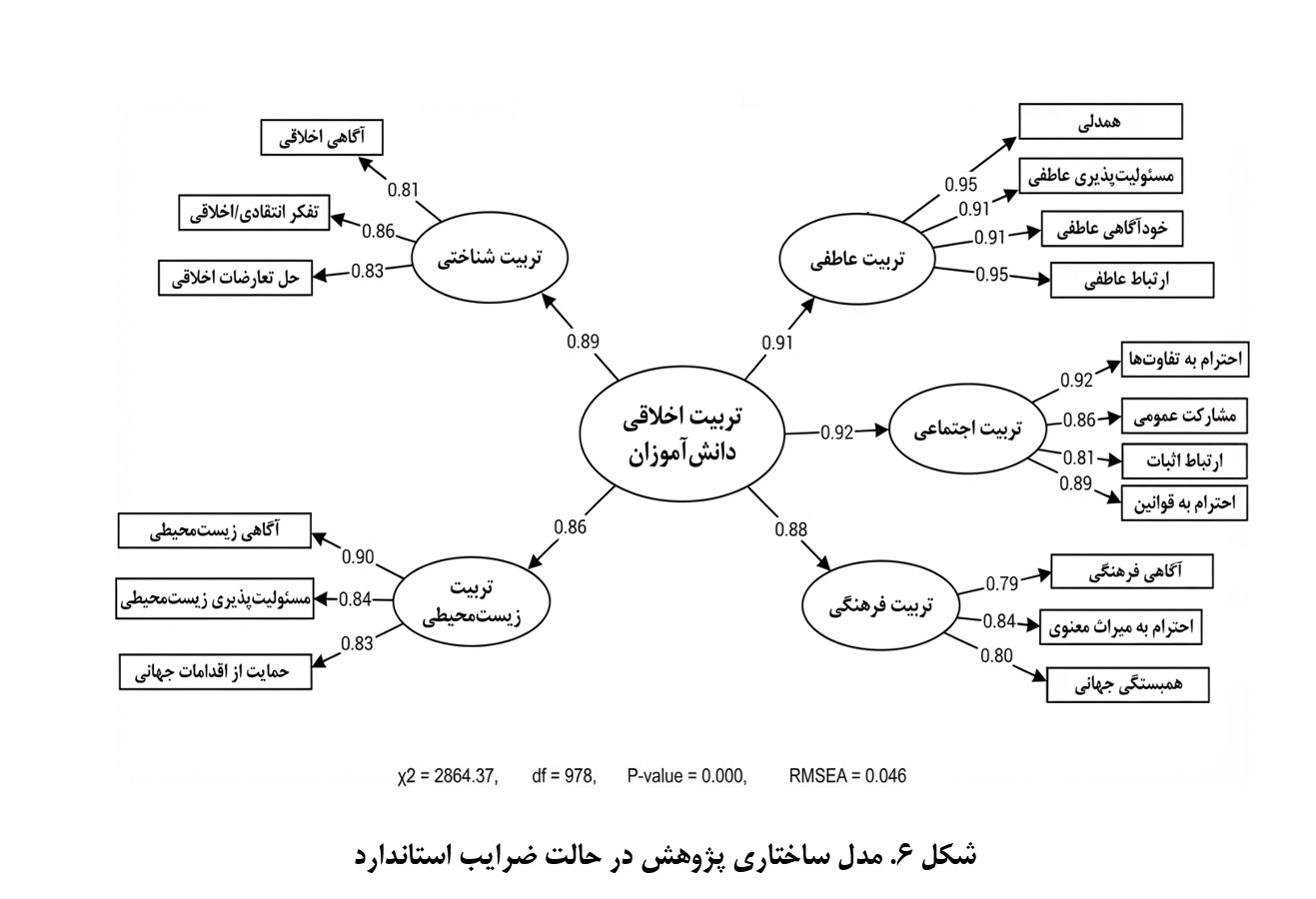
This study aimed to develop and validate a model of moral education for elementary school students in Tehran. This applied study employed an exploratory sequential mixed-methods design integrating qualitative and quantitative phases. In the qualitative phase, the study population consisted of university faculty members and experts in educational management, of whom 12 participants were purposively selected until theoretical saturation was achieved. Qualitative data were collected through semi-structured interviews and analyzed using open, axial, and selective coding as well as the Delphi technique. In the quantitative phase, the statistical population consisted of 3,525 elementary school teachers in Tehran holding at least a bachelor’s degree. Based on Morgan’s sample size table, 347 teachers were randomly selected. A researcher-made questionnaire developed from the qualitative findings was used for data collection, with an overall Cronbach’s alpha coefficient of 0.88. The quantitative data were analyzed using confirmatory factor analysis and structural equation modeling in LISREL. The qualitative analysis resulted in a model comprising five dimensions, 17 components, and 88 indicators. The five dimensions were cognitive, emotional, social, cultural, and environmental moral education. Confirmatory factor analysis showed that the relationships between the observed indicators and their corresponding latent constructs were statistically significant across all five dimensions (p<0.001). The final structural model also demonstrated an acceptable overall fit to the empirical data, with χ²/df=2.93, RMSEA≈0.047, CFI=0.94, IFI=0.94, RFI=0.92, GFI=0.91, and AGFI=0.90. These indices supported the structural validity and adequacy of the proposed model. The proposed five-dimensional model conceptualizes moral education among elementary school students as an integrated and multidimensional process involving cognitive, emotional, social, cultural, and environmental development. The validated model can provide an evidence-based framework for designing educational programs, developing moral education curricula, and informing educational policies and school-based practices aimed at strengthening moral development in elementary education.
Downloads
References
1. Rahnama A. An Introduction to Moral Education: Philosophical and Psychological Foundations, Approaches, and Methods of Moral Education. Tehran: Aeezh Publications; 2021.
2. Aghili SR, Elm al-Hoda J, Fathi Vajargah K. An Analysis of the Principles Governing the Design of an Optimal Moral Education Curriculum Model in the Primary Education Level of the Iranian Educational System. Educational Sciences. 2019;26(1):15-34. doi: 10.22055/edus.2019.26634.2585.
3. Abbasi D, Maleki H, Beheshti S. Designing a Moral Education Model in Higher Education Based on the Ethical Teachings of the Holy Qur'an from the Perspective of Tafsir al-Mizan Using Grounded Theory. New Educational Thoughts. 2019;15(2):99-122.
4. Heydarizadeh S, Esmaeili Z, Farajollahi M, Safaei T. Design and Validation of a Moral Education Model Appropriate to the Characteristics of Iranian Primary School Students with Emphasis on the Fundamental Transformation Document of Education. Research in Educational Systems. 2018;12(Special Issue):231-47.
5. Safarpour Feyzi M. Examining the Components of Moral Education in Thinking and Lifestyle Textbooks of Lower Secondary Education. Research in Art and Humanities. 2019;4(23):71-6.
6. Afzalkhani M. Content Analysis of Thinking and Lifestyle Textbooks in Lower Secondary Education from the Perspective of Moral Education. Thinking and Children. 2022;13(1):91-115.
7. Majdaldin T, Mirdamadi SM, Sarmadi MR. Designing a Model of Students' Moral Development within the Framework of the Philosophy of Islamic Education. Research in Islamic Education Issues. 2023;31(60):181-202.
8. Bagherianfar M, Dolati AA, Abdollahi N. Indicators of a Creative Classroom in Primary Education and the Degree of Attention Paid to Them by Pre-Service Student Teachers. Scientific Journal of Innovation and Creativity in Human Sciences. 2025;15(1):1-29.
9. Yaghoubi A, Moradiani F, Rasoul K. The Effect of Positive Thinking Skills Training on Creative Thinking, Outcome Expectations, and Irritability of Teachers. Scientific Journal of Innovation and Creativity in Human Sciences. 2025;14(4):164-88.
10. Salamah N. Curriculum Management to Shape Students' Competence in Knowledge, Religious Values, and Morals. Journal of Education and Learning Innovation. 2025;2(1):1-15. doi: 10.59373/jelin.v2i1.90.
11. Rohim A, Madzaly MYA. Analysis of Evaluation Techniques in the Book "Islamic Religious Education and Ethics" for Eleventh Grade Students of Madrasah Aliyah. Edukasi Islami Jurnal Pendidikan Islam. 2025;14(01):67-86. doi: 10.30868/ei.v14i01.8054.
12. Golshan A, Azimi M, Sadeghzadeh Balil N. Representation of Moral Education Components in Primary School Textbooks: A Meta-Synthesis Study. Qualitative Research in Educational Sciences. 2025;1(4):84-114.
13. Salehi M, Najafi A. Identifying Components Affecting Moral Education in the Content of Primary School Textbooks. Education, Training and Sustainable Development. 2025;1(3):18-27.
14. Koushi Z, Mousapour N, Armand M, Mohebbi A. Design and Validation of a Moral Education Model in the Primary Education Level of the Educational System of the Islamic Republic of Iran. 2020.
15. Tabatabaei Yazdi H. Design and Validation of a Moral Education Model in the Primary Education Level of the Iranian Educational System. Tenth National Conference on New Developments in Positive Psychology; Bandar Abbas2023.
Downloads
Published
Issue
Section
License
Copyright (c) 2026 الهام دوخایی (نویسنده); بهارک شیرزاد کبریا (نویسنده مسئول); عباس خورشیدی, فاطمه حمیدی فر (نویسنده)

This work is licensed under a Creative Commons Attribution-NonCommercial 4.0 International License.