Designing a School–Family–Community Ecosystem Partnership Model to Enhance the Psychological Capital of Elementary School Students
Keywords:
Ecosystem partnership, school, family, community, psychological capital, elementary school studentsAbstract
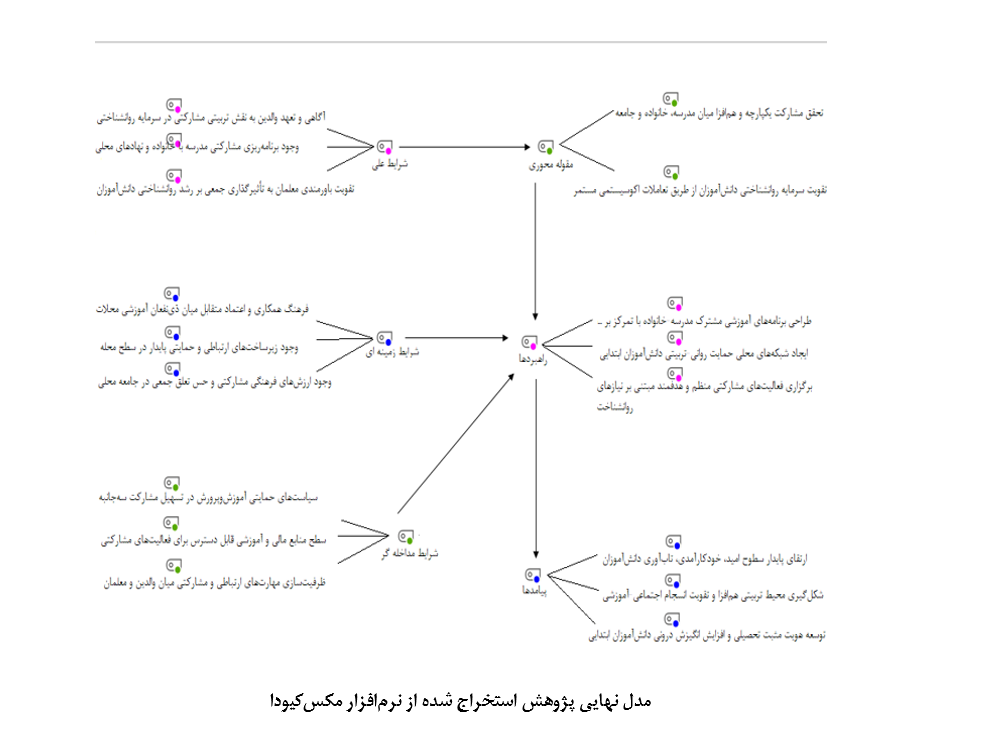
This study aimed to design a school–family–community ecosystem partnership model for enhancing the psychological capital of elementary school students. This qualitative study was conducted using a grounded theory approach. The study population comprised university faculty members, specialists, and experts with theoretical knowledge or practical experience in school–family–community partnerships and students’ psychological capital. Participants were selected through purposive sampling, which continued until theoretical saturation was achieved. After 21 semi-structured, in-depth interviews, no substantially new data emerged. The collected data were analyzed according to the Strauss and Corbin grounded theory framework through open, axial, and selective coding. The rigor of the study was assessed using the criteria of credibility, dependability, confirmability, and transferability. The analysis generated 240 open codes, 51 axial codes, and 18 selective codes. The causal conditions comprised parental awareness and commitment, participatory planning by schools, families, and local institutions, and teachers’ belief in collective efficacy for students’ psychological development. The central phenomenon consisted of integrated and synergistic school–family–community participation and the enhancement of students’ psychological capital through continuous ecosystem interactions. A culture of cooperation and mutual trust, sustainable communication infrastructures, and participatory cultural values emerged as contextual conditions. Supportive educational policies, accessible financial and educational resources, and the development of communication and partnership competencies were identified as intervening conditions. The principal strategies included designing joint school–family educational programs, establishing local psychoeducational support networks, and implementing regular, needs-based participatory activities. The anticipated outcomes included sustained improvements in hope, self-efficacy, and resilience, stronger socioeducational cohesion, a more synergistic educational environment, positive academic identity, and greater intrinsic motivation among elementary school students. Enhancing elementary students’ psychological capital requires a structured, continuous, and synergistic partnership among schools, families, and communities. The proposed model provides a context-sensitive framework for educational policymaking, collaborative interventions, and the development of supportive learning environments.
Downloads
References
1. Toumaj A, Mohammadifar MA, Tale Pasand S. The Relationship of Media Literacy and Psychological Capital with Students' Academic Engagement: Testing the Mediating Role of Social Cognition. Quarterly Journal of Psychology. 2025(115):443-53.
2. Nemati S, Badri Gargari R, Vahedi S, Boroumandzadeh N. Positive Psychology-Oriented Constructs in the Domain of Specific Learning Disabilities: A Systematic Review. Quarterly Journal of Exceptional Individuals Psychology. 2025(57):293-319.
3. Loghman S, Quinn M, Dawkins S, Woods M, Om Sharma S, Scott J. A Comprehensive Meta-Analysis of the Nomological Network of Psychological Capital. Journal of Leadership & Organizational Studies. 2022;30(1):108-28. doi: 10.1177/15480518221107998.
4. Nemati M, Shomali Oskouei A, Saberi H. The Mediating Role of Academic Self-Efficacy in the Relationship between Psychological Capital and Academic Procrastination among Students. Islamic Lifestyle with a Focus on Health. 2022;6(3):321-32.
5. Roudgarian M, Zameni F, Rasouli SE. The Effects of Self-Efficacy and Psychological Capital on Test Anxiety among Upper Secondary School Students in Babol. Journal of Mashhad University of Medical Sciences. 2021;64(5):4175-85.
6. Besharati Pour M, Hajiyakhchali A, Shehni Yailagh MSY, Maktabi G. The Effect of Psychological Capital Training on Students' Academic Engagement and Positive Emotions. Journal of Applied Psychological Research. 2024;15(3):139-59.
7. Mobaraki S, Rostami Asl S, Ghassabi Kohneshahri S, Asadi Soltanahmadi S. Psychological Capital and Its Role in Students' Academic Motivation. Sexual and Psychological Disorders. 2024;2(3).
8. Chen PL, Lin CH, Lin IH, Lo CO. The Mediating Effects of Psychological Capital and Academic Self-Efficacy on Learning Outcomes of College Freshmen. Psychological Reports. 2023;126(5):2489-510. doi: 10.1177/00332941221077026.
9. Carter JW, Youssef-Morgan C. Psychological Capital Development Effectiveness of Face-to-Face, Online, and Micro-Learning Interventions. Education and Information Technologies. 2022;27(5):6553-75. doi: 10.1007/s10639-021-10824-5.
10. Finch J, Waters AM, Farrell LJ. Developing the HERO Within: Evaluation of a Brief Intervention for Increasing Psychological Capital in Australian Female Students during the Final Year of School in the First Year of COVID-19. Journal of Affective Disorders. 2023;324:616-23. doi: 10.1016/j.jad.2022.12.169.
11. Hosseini Tabaghdahi L, Mahmoudi F, Yaghoubi AS. The Effectiveness of Cognitive Emotion-Regulation Strategy Training in Increasing the Subjective Vitality of Lower Secondary School Students. Quarterly Journal of Health Promotion. 2024;23(5):18-33.
12. Slåtten T, Lien G, Batt-Rawden VH, Evenstad SBN, Onshus T. The Relationship between Students' Psychological Capital, Social-Contextual Factors and Study-Related Outcomes: An Empirical Study from Higher Education in Norway. International Journal of Quality and Service Sciences. 2023;15(1):17-33. doi: 10.1108/IJQSS-11-2021-0160.
13. Peng JC, Chen SW. Learning Climate and Innovative Creative Performance: Exploring the Multilevel Mediating Mechanism of Team Psychological Capital and Work Engagement. Current Psychology. 2022. doi: 10.1007/s12144-021-02617-3.
14. Cai W, Yao H. The Effect of Parental Psychological Capital on Young Children's Social Skills Based on Structural Equation Modelling. Applied Mathematics and Nonlinear Sciences. 2023;9(1). doi: 10.2478/amns.2023.2.00957.
15. Ahghar G, Afrooz G, Akbari Zardkhaneh S. Designing a Family-Centered Psychological Strategies Model and Evaluating Its Effectiveness on the Spiritual Vitality of Upper Secondary School Students. Adolescent and Youth Psychological Studies. 2023;4(5):1-23.
16. Cui T, Wang C, Liu Q, Liu J. Domains of Parental Involvement and Academic Achievement across Grade Levels in the Chinese Context. Asia Pacific Journal of Education. 2023:1-17. doi: 10.1080/02188791.2023.2256989.
17. Tighbakhsh S, Baghi N, Mokhtari Z, Khodadoust M, Nik Ardestani M, Heydari Dehabadi K. Predicting Professional Engagement among Elementary School Teachers in Shiraz Based on Their Psychological Capital and Self-Efficacy. Quarterly Journal of Psychology and Educational Sciences. 2025;11(4):1-15.
18. Da Y, Ma Z, Gao Y. Psychological Capital as a Mediator in the Link between Organizational Socialization and Job Performance in Chinese Higher Education Teachers. Sustainability. 2024;16(13):5668. doi: 10.3390/su16135668.
19. Manafi B, Saroukhani B, Aghajani Marsa H. Designing a Strategic Model of Effective Communication between Family and School. Strategic Communication Studies. 2023;3(2).
20. Shoushtari A, Khazami P. A Framework for Parent-School Engagement through the Integration of Related Factors and Processes. New Research in Education. 2024;5(1).
21. Chu M, Fang Z, Mao L, Ma H, Lee CY, Chiang YC. Creating a Child-Friendly Social Environment for Fewer Conduct Problems and More Prosocial Behaviors among Children: A LASSO Regression Approach. Acta Psychologica. 2024;244:104200. doi: 10.1016/j.actpsy.2024.104200.
22. Alborzi M, Khoshbakht F, Ahmadi Fariabadi A. Examining Strategies to Enhance Students' Sense of Social Belonging and Learning Motivation in Virtual Education from Teachers' Perspectives: A Qualitative Study. Research in Educational Systems. 2022;16(59):61-74.
23. Masoumi N, Zabardast O, Mousavi SV, Rezaei S. The Effect of Teaching Persian Using Gagné's Instructional Design Model on Phonological Awareness and Problem-Solving Performance of Educable Students with Intellectual Disabilities. Quarterly Journal of Exceptional Individuals Psychology. 2024(56):191-211.
24. Feng T, Wang B, Mi M, Ren L, Wu L, Wang H, et al. The Relationships between Mental Health and Social Media Addiction, and between Academic Burnout and Social Media Addiction among Chinese College Students: A Network Analysis. Heliyon. 2025;11(3). doi: 10.1016/j.heliyon.2025.e41869.
25. Fei J, Hu Y, Liang L, Meng C, Mei S. Exploring the Impact of Emotional and Cognitive Factors on Anxiety Symptoms of Chinese Adolescents: A Serial Mediation Study. International Journal of Mental Health and Addiction. 2023. doi: 10.1007/s11469-022-01004-8.
Downloads
Published
Issue
Section
License
Copyright (c) 2025 Mona Voshagh, Hamid Shafizadeh, Fakhreddin Ahmadi, Narges Shariatmadari (Author)

This work is licensed under a Creative Commons Attribution-NonCommercial 4.0 International License.