Explaining the Role of Educational Management in the Development of Students’ Political Culture: A Qualitative Study
Keywords:
Educational Management, Political Culture, Students, Higher Education, Student Participation, University Governance, Qualitative ResearchAbstract
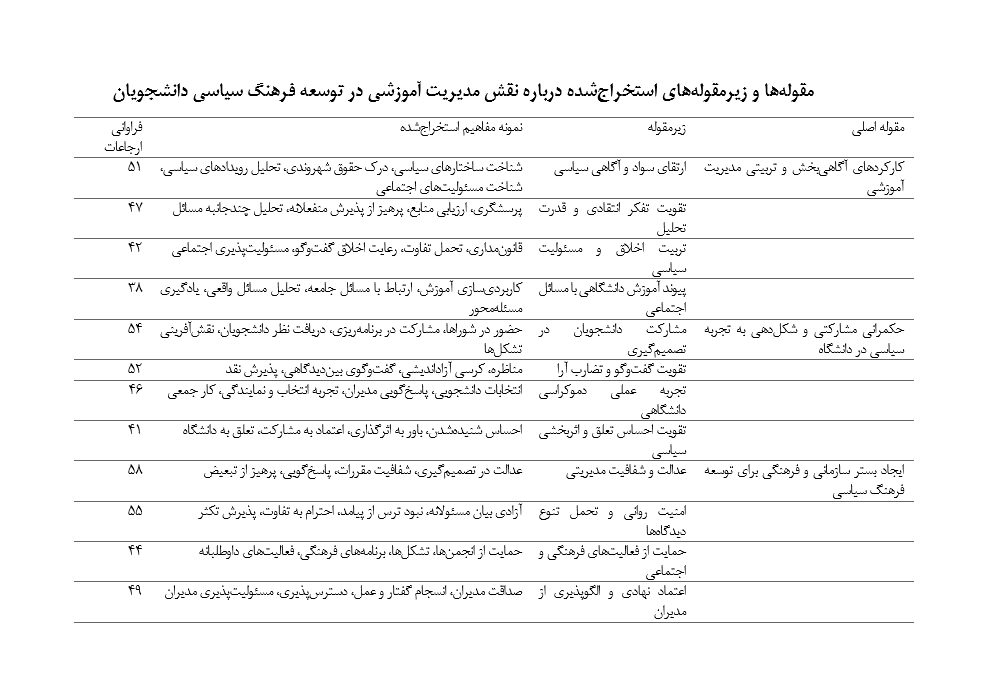
This study aimed to explain the role of educational management in the development of political culture among university students in Tehran. This qualitative study was conducted using conventional qualitative content analysis. The participants consisted of 22 individuals from universities in Tehran who were selected through purposive sampling with maximum variation, including 7 faculty members, 6 educational, cultural, or student-affairs managers and experts, and 9 postgraduate students. Data were collected through in-depth semi-structured interviews, and sampling continued until conceptual saturation was achieved. The interviews were transcribed verbatim and analyzed through identification of meaning units, initial coding, constant comparison, development of subcategories, and abstraction of overarching categories. Credibility and trustworthiness were enhanced through member checking, peer review, systematic documentation of the analytical process, and reflexive note-taking. Data analysis generated 168 initial codes, 64 final conceptual codes, 12 subcategories, and three overarching categories. The first category, “educational and awareness-building functions of educational management,” included political literacy and awareness, critical thinking, political ethics and responsibility, and connection of university education with social issues. The second category, “participatory governance and the formation of political experience in the university,” encompassed student participation in decision-making, dialogue and exchange of views, practical participatory experiences, and enhancement of belonging and political efficacy. The third category, “creation of an organizational and cultural context for political culture development,” included managerial justice and transparency, psychological safety and tolerance of diverse viewpoints, support for cultural and social activities, and institutional trust. Overall, educational management influenced political culture through three interconnected pathways: cognitive empowerment, participatory experience, and organizational legitimacy. The development of students’ political culture requires an integrated educational management approach that simultaneously strengthens political awareness, critical thinking, meaningful participation, fairness, transparency, psychological safety, and institutional trust, thereby transforming the university into a setting for the practical experience of social responsibility and constructive participation.
Downloads
References
1. Al-Ansari R, Al-Fahim O, Zang B. The Relationship Between Civic Education and Active Political Participation of Students. International Journal of Educational Narratives. 2025;3(2):105-13. doi: 10.70177/ijen.v3i2.2146.
2. Shevchenko H, Antonenko T, Zelenov E, Bezuhla M, Safonova I. Features of Education of the Political Culture of Students in a Post-Epidemic Society. Postmodern Openings. 2020;11(2):128-41. doi: 10.18662/po/11.2/166.
3. Shahmoradi M, Yousefzadeh Chousari MR. Presenting a political education curriculum model based on the socio-political domain of the Fundamental Reform Document for first secondary students. Journal of Research in Social Studies Education. 2020;5(1):173-206. doi: 10.29252/qaiie.5.1.173.
4. Yūsef Zādeh K, Shāhmorādī H. Presenting a Political Education Curriculum Model Based on the Socio-Political Education Dimension of the Fundamental Transformation Document of Education for First-Level Secondary School Students. Scientific-Research Quarterly of Applied Issues of Islamic Education and Training. 2020;5(1):173-206. doi: 10.29252/qaiie.5.1.173.
5. Jafari S, Ostadrahimi M. Predicting Students’ Social Movement Citizenship based on Open Classroom Climate, Political Efficacy and Civic Knowledge. iase-idje. 2023;6(4):28-38. doi: 10.61186/ijes.6.4.28.
6. Soltani A, Boostani D, Golestani S. Exploring the strategies of faculty-student interactions: A grounded theory study in Iranian academic context. Learning, Culture and Social Interaction. 2020;26:100408.
7. Black R, Mayes E. Feeling Voice: The Emotional Politics of ‘Student Voice’ for Teachers. British Educational Research Journal. 2020;46(5):1064-80. doi: 10.1002/berj.3613.
8. Fan X, Luchok K, Dozier J. College students’ satisfaction and sense of belonging: differences between underrepresented groups and the majority groups. SN Social Sciences. 2020;1(1):22. doi: 10.1007/s43545-020-00026-0.
9. Woolf E, Bie Ad. Politicizing Self-Advocacy: Disabled Students Navigating Ableist Expectations in Postsecondary Education. Disability Studies Quarterly. 2022;42(1). doi: 10.18061/dsq.v42i1.8062.
10. Miri Rami SF, Delgoshaei Y, Mahmoudi AH. Identification and Analysis of Effective Factors on the Strategic Intelligence of Education Districts Managers of Tehran City and Provide an Appropriate Model. Iranian Journal of Educational Sociology. 2022;5(1):113-25. doi: 10.61186/ijes.5.1.113.
11. Rahimi Asl R, Shirvani A, Soltani I. Presenting and teaching the model of goal-oriented and ethical organization in the public sector (Case study: Employees of Isfahan and Chaharmahal and Bakhtiari Tax Affairs Organization). Political Sociology of Iran. 2021;4(3). doi: 10.30510/psi.2022.302154.2217.
12. Wilson K, Sy J. A framework for managing innovation in higher education: lessons learnt from the UAE iPad initiative. Learning and Teaching in Higher Education: Gulf Perspectives. 2021;17(1):16-28. doi: 10.1108/LTHE-08-2020-0013.
13. Wang W. Research on Ideological and Political Education in Universities Under the "Simultaneous Development of Five Aspects" Student Management Model. Adult and Higher Education. 2023;5(17). doi: 10.23977/aduhe.2023.051713.
14. Hudia R, Affandi I. Students’ Perceptions of the Use of Instagram Social Media as One of Generation Z’s Political Education Facilities. 2022. doi: 10.2991/assehr.k.220108.057.
15. Proekt MAY, Khoroshikh VV, editors. Internet as a medium of modern students' political activity. The Herzen University Conference on Psychology in Education; 2021: Herzen State Pedagogical University of Russia.
16. Meng S. Role of Politically Motivated Internet Addiction and Ideological Passion in Linking College Student's Mental Health Education and Wellbeing. Frontiers in Psychiatry. 2022;13. doi: 10.3389/fpsyt.2022.973520.
17. Cao JJ, Yang T, Lai IKW, Wu J. Student acceptance of intelligent tutoring systems during COVID-19: The effect of political influence. International Journal of Electrical Engineering Education. 2021. doi: 10.1177/00207209211003270.
18. Fredua K-A. Relationship Between Public Funding and Student Access: The Case of Two Public Universities in Africa. Higher Education Politics and Economics. 2025;11(1):49-70. doi: 10.32674/4cq85h97.
19. Masaiti G, Mboyonga E. Financing and Resourcing International Collaboration in African Higher Education: Beyond Negotiated Power between the Global North and Global South. International Journal of African Higher Education. 2022;9(3):153-75. doi: 10.6017/ijahe.v9i3.16053.
20. Liao Y, Xie X. Research on Strategies of Colleges and Universities to Enhance the Sense of Acquisition of College Students’ Ideological and Political Education in the Context of Deep Learning. Applied Mathematics and Nonlinear Sciences. 2024;9(1). doi: 10.2478/amns-2024-0673.
21. Shahba M, editor Using educational games to strengthen students' financial literacy. Third International Conference on Political Science, Management, Economics, and Accounting; 2024; Hamedan.
22. Yarmakeev IE, Valiakhmetova N, Akhmadullina R, Nazarova OK, Gibadullin R. Art Pedagogy as a Means for Development of Educational Motivation of Students – Future Teachers. Revista on Line De Política E Gestão Educacional. 2021:387-97. doi: 10.22633/rpge.v25iesp.1.14975.
23. Kokka K. Healing-Informed Social Justice Mathematics: Promoting Students' Sociopolitical Consciousness and Well-Being in Mathematics Class. Urban Education. 2019;54(9):1179-209. doi: 10.1177/0042085918806947.
24. Doraghi S, Chualanzadeh Z, Borouni Z, editors. The Role of Teachers in the Political, Social, and Cultural Education of Students to Train an Aware Generation in Society2022; Hamadan.
25. Francis LJ, McKenna U. Self-Identifying as Anglican Within the Two Political Jurisdictions on the Island of Ireland: A Study Among Sixth-Form Students in the Greer Tradition. Ελληνική Περιοδική Έκδοση Για Τη Θρησκευτική Εκπαίδευση (Ελθε)/Greek Journal of Religious Education (Gjre). 2022;5(2):15-30. doi: 10.30457/050220222.
26. Jafarifar S, Torabi M. Future studies of socio-political education of students based on the Fundamental Reform Document of Education. Sepehr-e Siyasat Quarterly. 2021(28):96-116.
Downloads
Published
Issue
Section
License
Copyright (c) 2025 Mahdi Taghavi Rafsanjani (Corresponding author)

This work is licensed under a Creative Commons Attribution-NonCommercial 4.0 International License.