Designing an Educational Governance Model Based on the Political Participation of Stakeholders in the Higher Education System
Keywords:
Educational governance, Political participation, Stakeholders, Higher education, Participatory governance, Grounded theoryAbstract
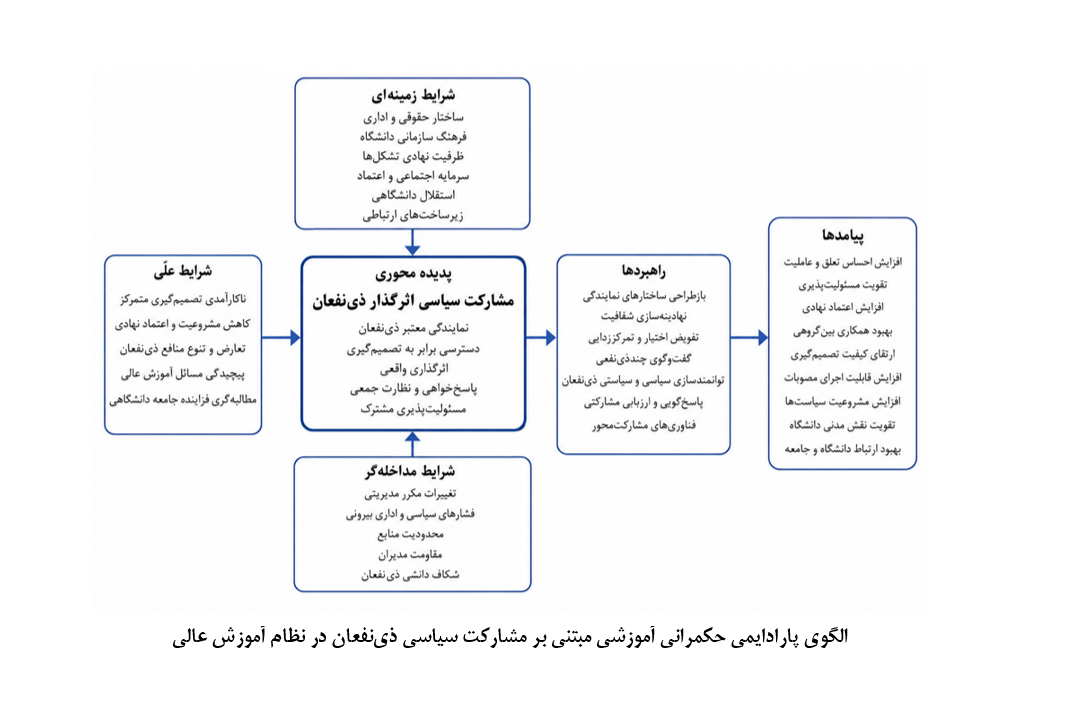
This study aimed to design an educational governance model based on the political participation of stakeholders in the Iranian higher education system. This qualitative study was conducted using the grounded theory methodology. The research setting included universities, higher education institutions, and organizations involved in higher education policymaking and administration in Tehran. Participants were selected through purposive and theoretical sampling and comprised 24 faculty members, university administrators and vice-presidents, higher education experts and policymakers, representatives of academic and student associations, and specialists in political science and public governance. Data were collected through in-depth semi-structured interviews and a supplementary review of relevant institutional and policy documents. Interviews continued until theoretical saturation was reached. Data collection and analysis were conducted concurrently through open, axial, and selective coding, constant comparison, and analytical memo writing. MAXQDA 2024 was used to organize and retrieve the qualitative data. The credibility and dependability of the findings were strengthened through member checking, peer review, and systematic documentation of analytical decisions. Data analysis generated 1,068 meaningful units, 786 initial codes, 214 conceptual codes, 48 subcategories, and 15 major categories. The central category was identified as “the transition from centralized and symbolic governance to participatory, accountable, and stakeholder-oriented governance.” The causal conditions included inefficient centralized decision-making, declining institutional trust, conflicts of interest, increasing complexity of higher education issues, and growing demands from the academic community. The core phenomenon was explained through legitimate representation, equal access to decision-making, actual influence, collective answerability, and shared responsibility. The principal strategies included redesigning representative structures, institutionalizing transparency, decentralizing authority, establishing multistakeholder dialogue, empowering stakeholders, developing participatory evaluation, and employing participation-oriented technologies. Educational governance based on stakeholders’ political participation can be realized when symbolic presence is replaced by meaningful, distributed, and accountable participation supported by legal, cultural, organizational, and technological infrastructures.
Downloads
References
1. Menon ME. The Process and Effectiveness of Strategic Planning in Higher Education: Evidence From Five European Countries. European Journal of Education. 2026;61(2). doi: 10.1111/ejed.70585.
2. Beerkens M. The Ruin of the Ivory Tower: The Emergence of the Stakeholder. 2023:417-28. doi: 10.4337/9781800888074.00044.
3. Abraham KJ. Midcentury Modern: The Emergence of Stakeholders in Democratic Practice. American Political Science Review. 2021;116(2):631-44. doi: 10.1017/s0003055421001106.
4. Bunea A, Nørbech I. Do Government Invitations to Consultations Shape Stakeholder Participation in Public Policymaking? European Journal of Political Research. 2025;64(4):1872-98. doi: 10.1111/1475-6765.70027.
5. Al-Thani G. Comparative Analysis of Stakeholder Integration in Education Policy Making: Case Studies of Singapore and Finland. Societies. 2024;14(7):104. doi: 10.3390/soc14070104.
6. Hadpagdee S, Choutikavatchagul S, Mason C, Aranyawat S, Hngokchai PW, Singtong PK, et al. Political Participation Instruction for Monk and Novice Students in Thailand. Linguistics and Culture Review. 2021;5(S3):161-72. doi: 10.21744/lingcure.v5ns3.1453.
7. Mudau P. Promoting Civic and Voter Education Through the Use of Technological Systems During the COVID-19 Pandemic in Africa. African Human Rights Law Journal. 2022;22(1):1-31. doi: 10.17159/1996-2096/2022/v22n1a5.
8. Hovakimyan H, Klimek M, Freyer B, Hayrapetyan R. Sustainable Shift From Centralized to Participatory Higher Education in Post-Soviet Countries: A Systematic Literature Review. Sustainability. 2021;13(10):5536. doi: 10.3390/su13105536.
9. Zhuang T, Liu B, Hu Y. Legitimising Shared Governance in China's Higher Education Sector Through University Statutes. European Journal of Education. 2022;57(1):33-48. doi: 10.1111/ejed.12493.
10. Haniff N, Daya P. Distributed Leadership: A Model for Student Leadership Engagement. South African Journal of Higher Education. 2023. doi: 10.20853/37-4-5078.
11. Balıkçı A. Examining the Impact of National Education Councils on Education Management Policies. Uluslararası Temel Eğitim Çalışmaları Dergisi. 2023;4(3):83-98. doi: 10.59062/ijpes.1366365.
12. M. KA, Oino PG. The Effect of Stakeholder Involvement on Institutional Productivity in Selected Public Universities in Uganda. International Journal for Multidisciplinary Research. 2024;6(4). doi: 10.36948/ijfmr.2024.v06i04.24062.
13. Khachatryan R. Leveraging Stakeholder Engagement for Enhanced Higher Education Competitiveness in Armenia. Education in the 21st Century. 2023;9(1):33-41. doi: 10.46991/ai.2023.1.33.
14. Mugabo JP. Stakeholders’ Engagement and Sustainability of Educational Projects: A Case of Teacher Development Through School-Based Mentorship Project in Ngoma District, Rwanda. Journal of Entrepreneurship & Project Management. 2023;7(4):11-29. doi: 10.53819/81018102t3084.
15. Biswakarma G, Dhakal N. Policy Implementation of Quality Assurance and Accreditation in the Nepalese Higher Education Institutions Offering Hospitality Education. The Arab Journal for Quality Assurance in Higher Education. 2023;15(54):24-50. doi: 10.20428/ajqahe.v15i54.2171.
16. Dao THT. An Evaluation of the Quality Management System of Transnational Undergraduate Programmes in a Vietnamese University. 2022. doi: 10.31219/osf.io/6hw3s.
17. Ashu FE. Widening Participation and the Provision of High Quality Teaching and Learning in Higher Education Improvement Programmes: A Case Study of the University of Buea. Asian Journal of Education and Social Studies. 2021:29-42. doi: 10.9734/ajess/2021/v25i330602.
18. Bidandi F, Nofor AA, Mukong C. Collaboration and Partnerships Between South African Higher Education Institutions and Stakeholders: Case Study of a Post-Apartheid University. 2022. doi: 10.21203/rs.3.rs-1371503/v2.
19. Bidandi F, Ambe NA, Mukong C. Collaboration and Partnerships Between Higher Education Institutions and Variousstakeholders: Case Study, the University of the Western Cape, South Africa. 2022. doi: 10.21203/rs.3.rs-1371503/v1.
20. Ebekozien A, Samsurijan MS, Aigbavboa C, Firdaus RBR, Azazi NAN, Amadi GC. Infrastructure Development in Higher Institutions: The Role of Private Organisations via Unexplored Expanded Corporate Social Responsibility (ECSR). Property Management. 2022;41(1):149-68. doi: 10.1108/pm-03-2022-0015.
21. Mkhize TR, Hungwe JP. All Hands on Deck! School-Community Partnerships as a Nexus for Resource Mobilisation in South African Rural Schools. Education Research International. 2022;2022:1-13. doi: 10.1155/2022/5286467.
22. Tercanli H, Jongbloed B. A Systematic Review of the Literature on Living Labs in Higher Education Institutions: Potentials and Constraints. Sustainability. 2022;14(19):12234. doi: 10.3390/su141912234.
23. Makrakis V, Kostoulas‐Makrakis N. A Participatory Curriculum Approach to ICT-Enabled Education for Sustainability in Higher Education. Sustainability. 2023;15(5):3967. doi: 10.3390/su15053967.
24. Venn R, Pérez P, Vandenbussche V. Competencies of Sustainability Professionals: An Empirical Study on Key Competencies for Sustainability. Sustainability. 2022;14(9):4916. doi: 10.3390/su14094916.
25. Gwama UM. Transformative Approaches to Managing Student Unrest in a South African University. Interdisciplinary Journal of Management Sciences. 2024;1:1-12. doi: 10.38140/ijms-2024.vol1.11.
26. Nqabeni P, Maqhubela V, Cishe EN. Social Transformation in Eastern Cape Universities, South Africa: Myth or Reality? E-Journal of Humanities Arts and Social Sciences. 2024:1182-94. doi: 10.38159/ehass.20245710.
27. Doshmangir L, Somi M, Lak S, Kabiri N, Ebrahimipour H, Barati O, et al. Selection and Appointment of Presidents of Medical Universities in Iran: Bridging Reality and Ideal Through Global and Local Evidence. Plos One. 2025;20(6):e0326563. doi: 10.1371/journal.pone.0326563.
28. Huang Y-C, Park SJ, Wang R-J. Direct Election of Education Superintendents in Korea: Dilemmas and Improvement Strategies. International Journal of Comparative Education and Development. 2024;26(2):81-94. doi: 10.1108/ijced-07-2023-0071.
29. Romiani Y, Khorasgani MSG, Norollahee S. Higher Education Managers’ Perception of University Reputation Components: A Model for Middle Eastern Countries. International Journal of Educational Management. 2024;38(2):525-48. doi: 10.1108/ijem-09-2023-0433.
30. Munusamy MM, Hashim A. An Analysis of the ASEM Education Process and Its Role in Higher Education. European Journal of Education. 2021;56(3):468-81. doi: 10.1111/ejed.12462.
31. Kibirige I. Stakeholders’ Roles and Motivations in the Management of Wetlands in Uganda: A Case Study of Lutembe Bay Wetland. The Journal of Environment & Development. 2026;35(2):492-519. doi: 10.1177/10704965251412778.
32. Kyambadde JM, Khumalo SS. Universalization, Sustainability and “Justiceness” of Primary Education: Perspectives and Lessons From Uganda. Discourse and Communication for Sustainable Education. 2023;14(2):144-60. doi: 10.2478/dcse-2023-0023.
33. Raza GKN. Sustainability of Tourism Planning in the Province of Marinduque. International Journal of Management Studies and Social Science Research. 2022;04(05):109-69. doi: 10.56293/ijmsssr.2022.4513.
Downloads
Published
Issue
Section
License
Copyright (c) 2025 Mahdi Taghavi Rafsanjani (Corresponding author)

This work is licensed under a Creative Commons Attribution-NonCommercial 4.0 International License.