The Impact of Mother–Daughter Social Intimacy on the Prevention of Social Harms: A Sociological Study among Female University Students
Keywords:
Social harms, Social intimacy, Mother–daughter relationship, Female university students, Family, PreventionAbstract
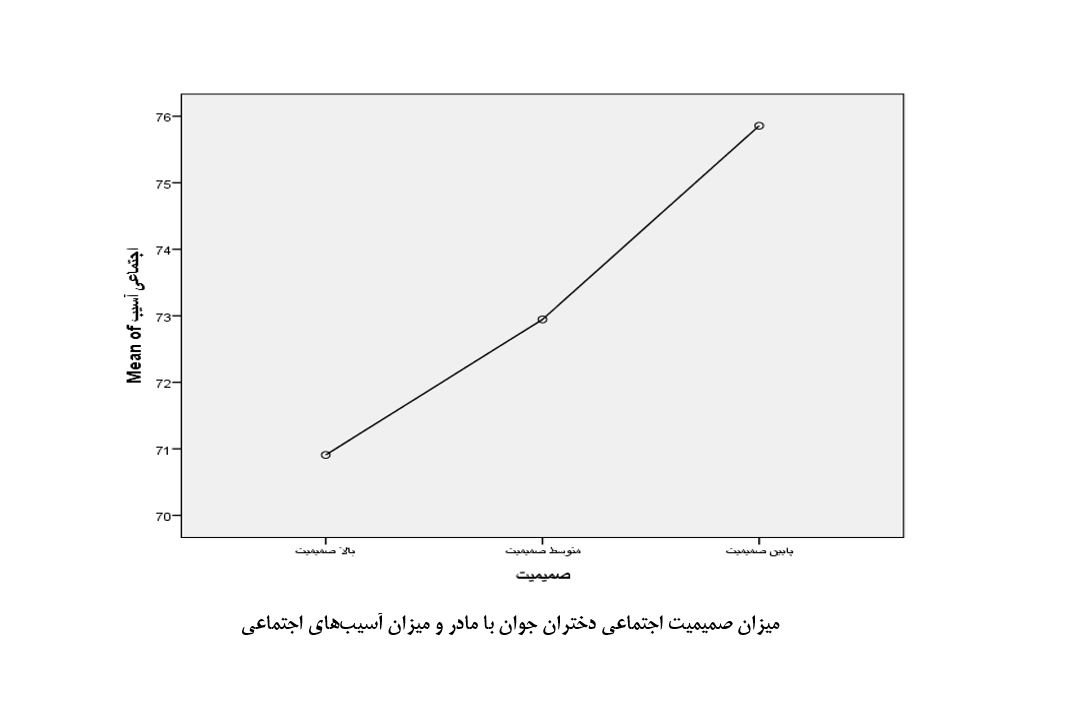
This study aimed to investigate the role of mother–daughter social intimacy in reducing social harms among young women and to examine whether maternal place of residence and educational attainment influenced this relationship. This survey study was conducted among unmarried first-semester female undergraduate students at Payame Noor University, Maragheh Center. A total of 312 students were selected through simple random sampling. Data were collected using the Miller and Lefcourt (1982) Social Intimacy Scale and the Social Harms Questionnaire developed by Aghaei et al. (2010), together with interviews. Inferential data analysis was performed using one-way and two-way analyses of variance (ANOVA). One-way ANOVA indicated a significant relationship between the level of mother–daughter social intimacy and social harms (F=13.023, p<0.001), with greater intimacy associated with lower involvement in social harms. In the analysis involving place of residence, the main effect of social intimacy was significant (F=8.071, p<0.001), whereas neither the main effect of residence (F=1.446, p=0.230) nor the social intimacy × residence interaction (F=0.238, p=0.788) was significant. Similarly, the main effect of social intimacy remained significant when maternal education was considered (F=7.184, p=0.001). However, neither maternal education (F=0.646, p=0.630) nor the social intimacy × maternal education interaction (F=0.404, p=0.918) showed a statistically significant effect. Higher mother–daughter social intimacy appears to function as an important protective factor against young women’s involvement in social harms. This association was evident regardless of maternal place of residence or educational level. Accordingly, interventions designed to strengthen mutual trust, emotional support, empathy, and intimate communication between mothers and daughters may contribute to the prevention of social harms and the promotion of social well-being among young women.
Downloads
References
1. Heydari G. Durkheim's Social Pathology Based on the Pathological-Normal Model of Modern Medicine. Scientific Quarterly of Methodology of the Humanities. 2021;27(106):1-11.
2. Aghaei A, Teymourtash H. Examining the Relationship and Process of Social Pathology and Social Security. Daneshnameh: Political Sciences. 2010(78):3-22.
3. Giddens A. The Consequences of Modernity. Tehran: Markaz Publication; 2009.
4. Arnett JJ. Emerging Adulthood: A Theory of Development from the Late Teens Through the Twenties. American Psychologist. 2000;55:469-80.
5. Golchin M. Youth Social Deviance in the Mirror of Research: An Example of the Application of Secondary Analysis. Quarterly Journal of Social Sciences. 2006(11):23-8.
6. Damiri F. Examining Factors Affecting Young People's Tendency Toward Social Harms in Neyriz City. Tenth National Conference on New Developments in Positive Psychology; Bandar Abbas2023.
7. Falahati R, editor The Effect of Poverty and Family Economic Problems on Adolescents' Social Harms. Third International Conference on Smart Technologies in Educational Sciences, Psychology, Counseling, and Philosophy; 2025.
8. Salehi F. Investigating students' social harms based on the FOMO phenomenon and parenting styles in the context of social network use. Scientific Quarterly of New Research in Education. 2025(3).
9. Samad Abedini S, Jafari H. Examining Social Factors Related to Tendency Toward Social Abnormality Among First-Cycle Secondary School Students in Khalkhal in the 2014-2015 Academic Year. Strategic Research on Social Problems in Iran. 2018;7(21):37-52. doi: 10.22108/SSOSS.2018.100570.0.
10. Zolfalifam J, Mowgher M, Torabi Aghdam J. Examining the Relationship Between Social Bonding and Social Deviance Among Local and Non-Local University Students. Proceedings of the Second National Conference on Social Harms. Tehran: Agah Publications; 2012. p. 101-31.
11. Karimi M, Estebraghi M, Hosseinzadeh Oskouei A, Kazemian S. The Relationship Between Mother-Child Interaction and Mental Health of Adolescent Girls: The Mediating Role of Religious Identity. Journal of Health Research. 2019;8(2):67-75.
12. Miller RS, Lefcourt HM. The Assessment of Social Intimacy. Journal of Personality Assessment. 1982;46(5):514-51.
13. Erikson EH. Life History and the Historical Moment. New York: Norton; 1975.
14. Montgomery MJ. Psychological Intimacy and Identity: From Early Adolescence to Emerging Adulthood. Journal of Adolescent Research. 2005;20:346-74.
15. Shahraei M, Daneshvarpour Z, Tajik Esmaeili A, Valia F, Shokri A. Sex Differences in Social Intimacy: The Role of Identity Styles. Iranian Journal of Psychiatry and Clinical Psychology. 2007;13(4):393-404.
16. Das N. Processes of Negotiating Intimate Heterosexual Identities and Relations: Narratives of Three Generations of Urban Middle-Class Bengalis Living in Kolkata, India: University of Birmingham, Department of Political Science and International Studies; 2013.
17. Lotfizadeh A, Zahedi Mazandarani M. Transformation of Intimacy Practices: A Comparative Analysis of Marital Intimacy Among Three Generations of Women in Tabriz. Women in Development and Politics. 2022;20(4):557-86. doi: 10.22059/JWDP.2022.341576.1008195.
18. Sadeghieh S, Kalateh Sadati A, Afrasiabi H. Exploring the Right to Intimacy from the Perspective of Generation-Z Girls: A Qualitative Study in Yazd City. Quarterly Journal of Social Problems of Iran. 2024;15(3):129-62.
19. Khani R, Hosseinabadi M, Motadaveli F, Bostani S. Investigating the Effectiveness of Group Training Based on Cognitive Reconstruction in Increasing Students' Social Intimacy. Conference on Management and Human Sciences Research in Iran2023. p. 3392-8.
20. Zamanpour Z, Rezaei F. The Effect of Assertiveness Training Based on a Cognitive-Behavioral Perspective on Social Intimacy and Academic Achievement Motivation of First-Cycle Secondary School Students in Shahin Shahr. Sixth National Conference on Management and Humanities Research in Iran; Tehran2019.
21. Kazemi Z, Taher Neshatdoost H, Kojbaf M, Abedi A, Aghamohammadi S, Sadeghi S. The Effectiveness of Transactional Analysis Training on Social Intimacy of Runaway Girls in Isfahan: A Single-Case Study. Quarterly Journal of Psychosocial Studies of Women. 2012;1:139-62. doi: 10.22051/JWSPS.2012.1422.
22. Kord H, Bameri E, Kord A, Kord H. Examining and Comparing Perceived Parenting Styles with Intimacy and Forgiveness in University Students. Journal of Psychological Dynamics in Mood Disorders (PDMD). 2024;3(1):1-11. doi: 10.22034/pdmd.2024.434759.1040.
Downloads
Published
Issue
Section
License
Copyright (c) 2025 Jafar Zolfalifam (Corresponding author)

This work is licensed under a Creative Commons Attribution-NonCommercial 4.0 International License.