Designing an Educational Model for Out-of-School Children Based on UNICEF Experiences: A Qualitative Grounded Theory Study
Keywords:
Out-of-school children, educational model, model design, UNICEF, educational justice, grounded theoryAbstract
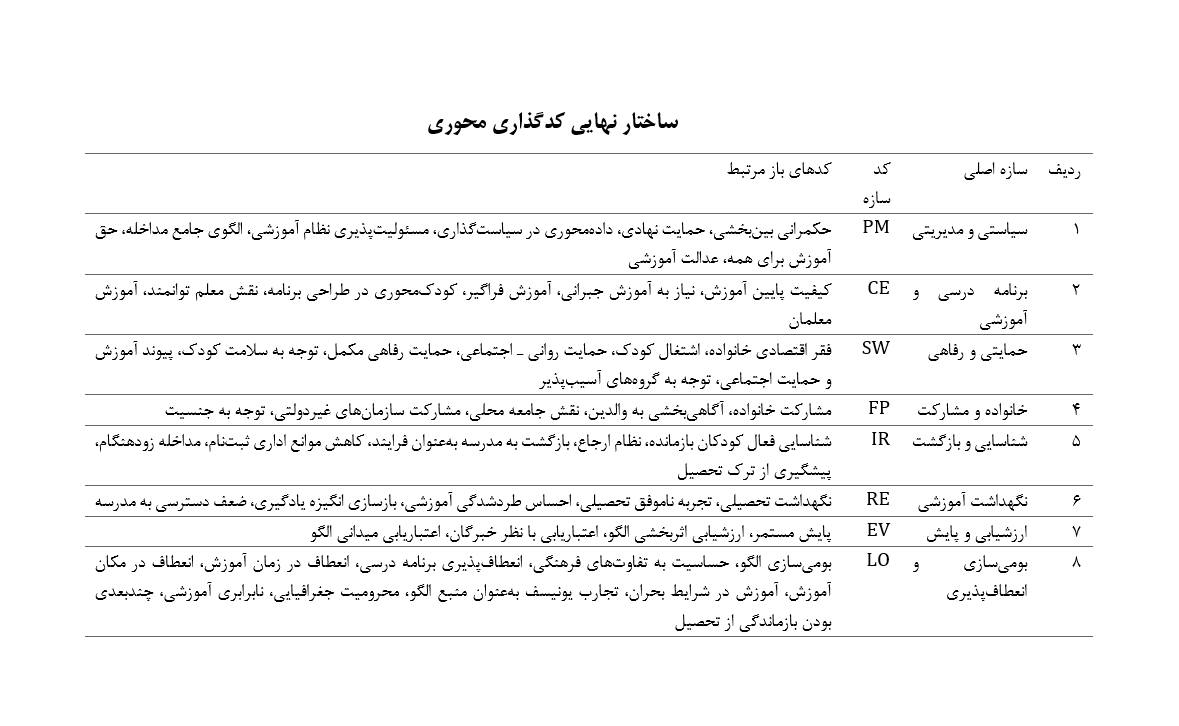
This study aimed to design a comprehensive, localized, and flexible educational model for out-of-school children based on UNICEF experiences using a grounded theory approach. This applied-developmental study employed a qualitative grounded theory design. Participants consisted of 18 experts, specialists, educational managers, policymakers, and scholars in education, curriculum planning, educational management, educational equity, child support, and related fields. Participants were initially selected through purposive sampling, followed by theoretical sampling until theoretical saturation was achieved. Data were collected through in-depth semi-structured interviews and documentary analysis. Interviews lasted between 48 and 64 minutes. Data were analyzed through open, axial, and selective coding using MAXQDA 2022. Credibility, transferability, dependability, and confirmability were considered to enhance the trustworthiness of the findings. The analysis indicated that an effective educational model for out-of-school children comprises eight interrelated dimensions: policy and management, curriculum and education, support and welfare, family and participation, identification and return, educational retention, evaluation and monitoring, and localization and flexibility. The findings further indicated that educational exclusion is a multidimensional phenomenon and that sustainable return to education requires simultaneous interventions addressing educational, socioeconomic, familial, institutional, and contextual barriers. The core category was identified as “designing and validating a comprehensive, localized, and flexible educational model for out-of-school children based on UNICEF experiences.” The resulting paradigmatic structure suggested that sustainable reintegration depends on the interaction of supportive conditions, appropriate governance, flexible educational strategies, active identification mechanisms, and continuous monitoring. The proposed model suggests that policies for out-of-school children should move beyond a narrow enrollment-oriented approach toward a continuous process encompassing identification, needs assessment, referral, educational reintegration, remedial learning, psychosocial support, retention, and monitoring. Contextual adaptation of UNICEF experiences, together with intersectoral coordination and flexible educational pathways, may strengthen sustainable school return, reduce repeated dropout, promote educational inclusion, and advance educational equity.
Downloads
References
1. Ali M, Hussain S. Educational policies and their impact on out-of-school children: A case study. International Journal of Educational Development. 2023;95:102-10.
2. Jeong K-H, Lee SH, Park AR, Song D-H. Effects of Parenting Attitudes on the Suicide Risk of Adolescents in South Korea and the Moderating Effect of Out-of-School Youth Status. Cambridge Prisms Global Mental Health. 2025;12. doi: 10.1017/gmh.2025.35.
3. Lee S-H. Analyzing Delinquent Peer Factors in Cyber Violence Among Out-of-School Youth. Korean Association of Public Safety and Criminal Justice. 2023;32(2):195-220. doi: 10.21181/kjpc.2023.32.2.195.
4. Renick J, Schaefer DR. Increasing Ties to Peers and Improving Social Emotional Outcomes: Insights From an Out-of-School Program Serving Latine Young Adolescents. The Journal of Early Adolescence. 2025. doi: 10.1177/02724316251330907.
5. Hong SK, Kim CH. A Case Study on Out-of-School Youth Withdrawal and Career Choice. Korean Association for Learner-Centered Curriculum and Instruction. 2023;23(15):713-26. doi: 10.22251/jlcci.2023.23.15.713.
6. Deer G, Wu H, Zhang L, Tadesse E, Khalid S, Duan C, et al. Effect of Out-of-School Visual Art Activities on Academic Performance. The Mediating Role of Socioeconomic Status. Plos One. 2024;19(5):e0298901. doi: 10.1371/journal.pone.0298901.
7. World B. Why do girls drop out of school and what are the consequences of dropping out? 2018. Available from: https://medium.com/world-of-opportunity/why-do-girls-drop-out-of-school-f2762389a07e.
8. Khosravizadeh E, Shahmansouri E, Roshanzadeh J. Inhibitor Factors to Girl Students’ Participation in Out-of-School Sport Activities. Strategic Studies on Youth and Sports. 2014;13(25):213-30.
9. Karamustafaoğlu O, Pektaş HM. Developing students' creative problem solving skills with inquiry-based STEM activity in an out-of-school learning environment. Education and Information Technologies. 2023;28(6):7651-69. doi: 10.1007/s10639-022-11496-5.
10. Larsen Y, Groß J, Bogner FX. Bringing Out-of-School Learning Into the Classroom: Self- Versus Peer-Monitoring of Learning Behaviour. Education Sciences. 2020;10(10):284. doi: 10.3390/educsci10100284.
11. Pienimäki M, Kinnula M, Iivari N. Finding fun in non-formal technology education. International Journal of Child-Computer Interaction. 2021;29:100283. doi: 10.1016/j.ijcci.2021.100283.
12. Boichenko M, Чистякова І, Boichenko A. Creative Individuality of the Pupils of Out-of-School Education Institutions of Artistic-Aesthetic Direction: Essence and Structure. Zhytomyr Ivan Franko State University Journal Рedagogical Sciences. 2021(4(107)):5-13. doi: 10.35433/pedagogy.4(107).2021.5-13.
13. Wei D. Methods of Forming Aesthetic Taste in Schoolchildren Using Dance in Out-of-School Education Institutions. Education Innovation Practice. 2023;11(10):127-31. doi: 10.31110/2616-650x-vol11i10-019.
14. Burns EC, Martin AJ, Kennett R, Pearson J, Munro-Smith V. High school students' out-of-school science participation: A latent class analysis and unique associations with science aspirations and achievement. Journal of Research in Science Teaching. 2021. doi: 10.1002/tea.21806.
15. Verdín D, Godwin A, Sonnert G, Sadler PM. Understanding How First-Generation College Students’ Out-of-School Experiences, Physics and STEM Identities Relate to Engineering Possible Selves and Certainty of Career Path. 2018:1-8. doi: 10.1109/fie.2018.8658878.
16. Wilson S, Rennie J. “The very ugly duckling” meets Minecraft: identity work and interpretive competence. Literacy. 2019;53(4):206-15.
17. Barkoukis V, Chatzisarantis NLD, Hagger MS. Effects of a School-Based Intervention on Motivation for Out-of-School Physical Activity Participation. Research Quarterly for Exercise and Sport. 2020;92(3):477-91. doi: 10.1080/02701367.2020.1751029.
18. Shytikova Y, Kohut I, Marynych V. Technology of Organizing Inclusive Education in Modelship Sports in Institutions of Out-of-School Education. Слобожанський Науково-Спортивний Вісник. 2022;26(4):109-14. doi: 10.15391/snsv.2022-4.003.
19. Savchuk B, Султанова Н, Bilavych H, Pantyuk T. Two-Tier Model Оf Training Future Teachers for Coaching at Out-of-School Institutions. Pedagogika-Pedagogy. 2022:177-95. doi: 10.53656/ped2022-2.03.
20. Malorni A, Lea CH, Richards-Schuster K, Spencer MS. Facilitating youth participatory action research (YPAR): A scoping review of relational practice in US Youth development & out-of-school time projects. Children and Youth Services Review. 2022:106399. doi: 10.1016/j.childyouth.2022.106399.
21. Bakare J, Ohanu IB, Shodipe TO. Hypothesized Model of the Relationship Between Affective Behaviour, Emotional Intelligence and Success of Out-of-School Youths in Cell Phone Maintenance Enterprise. Rajagiri Management Journal. 2023;17(3):254-77. doi: 10.1108/ramj-06-2022-0102.
Downloads
Published
Issue
Section
License
Copyright (c) 2025 Zahra Kazemi (Author); Manizheh Zakaryaei (Corresponding author); Rasoul Davoudi (Author)

This work is licensed under a Creative Commons Attribution-NonCommercial 4.0 International License.