Designing and Validating a Child-Rights-Based Curriculum Model in the Teacher Education System: A Case Study of Farhangian University
Keywords:
Design and validation, Curriculum template, Teacher training system, Farhangian UniversityAbstract
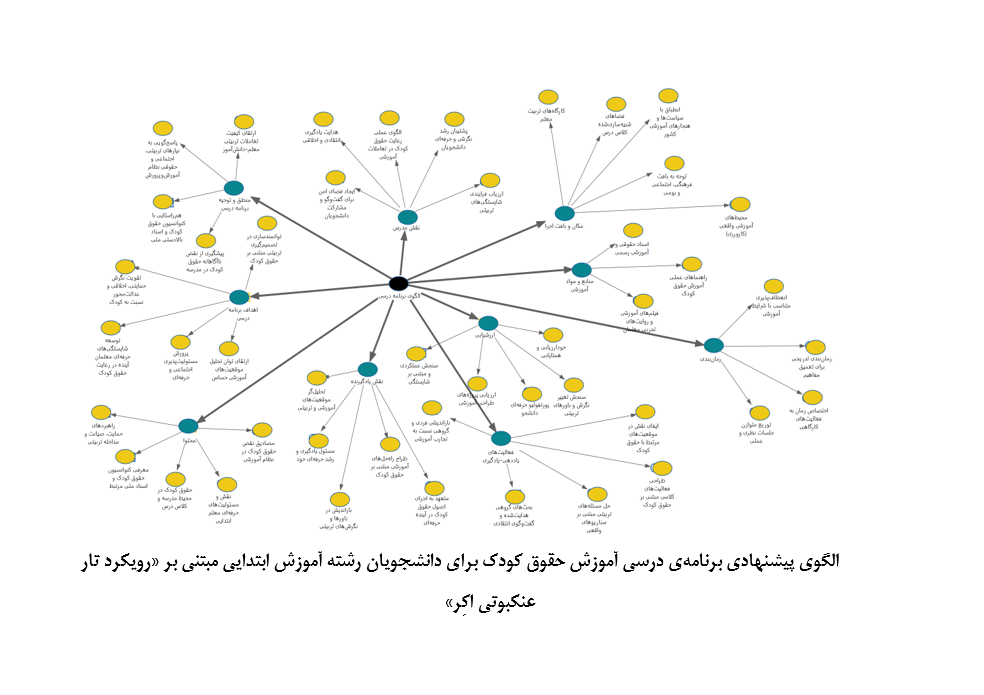
This study aimed to design and validate a comprehensive child-rights-based curriculum model for the teacher education system at Farhangian University. This applied study employed a sequential exploratory mixed-methods design conducted in three stages. First, a qualitative meta-synthesis of 34 relevant studies was undertaken to identify the preliminary components of the model. Second, semi-structured interviews were conducted with 11 university faculty members, curriculum specialists, and legal experts selected through purposive and snowball sampling until theoretical saturation was achieved. The qualitative data were analyzed through thematic analysis using open, comparative, and categorical coding procedures. The content validity of the extracted components was subsequently assessed through Lawshe’s method and the judgments of 15 experts. In the quantitative stage, a researcher-developed questionnaire was administered to 201 school principals, teachers, and curriculum experts who had graduated from Farhangian University. The proposed model was validated using partial least squares structural equation modeling in SmartPLS 3. The meta-synthesis identified 26 intermediate categories organized into six principal factors. The expert interviews produced 37 components classified under ten curriculum elements: rationale, objectives, content, teaching–learning processes, teacher role, learner role, materials and resources, assessment, scheduling, and implementation setting and context. All components demonstrated acceptable content validity, and the overall content validity ratio was 0.847. Cronbach’s alpha and composite reliability coefficients exceeded 0.70 for all constructs, while average variance extracted values were greater than 0.50, confirming internal consistency and convergent validity. Moreover, the overall goodness-of-fit index of 0.328 indicated an acceptable fit between the proposed conceptual structure and the empirical data. The validated model provides an integrated framework for redesigning teacher education curricula. By combining educational justice and inclusion, child dignity and safety, meaningful participation, explicit rights education, and civic and ethical competencies, the model can prepare prospective teachers to establish safe, inclusive, participatory, and rights-oriented learning environments in which children’s differences and voices are recognized.
Downloads
References
1. Salimi J, Ghobadi A, Amini Bagh A. A Phenomenographic Study of Teachers' Understanding and Perception of the Concepts of Curriculum and Curriculum Planning. Curriculum and Learner-Centered Instruction. 2025;4(2):109-35. doi: 10.22034/cipj.2025.65834.1228.
2. Nasrollahi-Kalroud R, editor The Role of Curriculum Planning in Advancing Educational Goals. National Conference on Humanities with a Modern Approach; 2024.
3. Saghaholeslami A. Curriculum Planning and Development of Educational Syllabi for Research Ethics. Ethics in Science and Technology. 2023;18(3):92-101.
4. Ahmadi V, Mousapour N, Baharvand Z. Evaluation of the Efficiency of the Master's Program in Curriculum Planning at Farhangian University. Theory and Practice in Teacher Education. 2024;10(17):207-22.
5. Shaban M. Analysis of the Structure of Children's Rights in Iran: Examining the National Authority of the Convention on the Rights of the Child Based on the International Convention on the Rights of the Child. Legal Civilization. 2021;4(9). doi: 10.22034/lc.2022.134888.
6. Mahjoub S. The Child's Right to Support and Its Methodology in the Convention on the Rights of the Child and the Iranian Legal System. Philosophy of Law. 2023;2(1):141-66. doi: 10.22081/phlq.2024.68240.1050.
7. Azarpandar A. The Approach of the European Court of Human Rights in Explaining the Concept of the Best Interests of the Child in Relation to the Right to Family Life in Asylum Case Law. International Law Journal. 2025:e725466. doi: 10.22066/cilamag.2025.2058966.2729.
8. Kashi Komijani M, Rajaei M. A Comparative Study of Children's Right to Education from the Perspective of the Convention on the Rights of the Child and Iranian Constitutional Law. Comparative Public Law. 2024;1(2):111-30.
9. Moody Z. Children's Rights to, in and through Education: Challenges and Opportunities. Centre for Children's Rights Studies, University of Geneva, 2021.
10. Azimi M. A Critical Analysis of Children's Rights in Iranian Educational Content. Journal of Curriculum Studies. 2022;14(3):57-80.
11. Sabzeh B, Bazgir T, Samipour M. Content Analysis of Elementary School Textbooks Based on Components of Children's Rights. Social Welfare. 2025;25(99):211-28. doi: 10.32598/refahj.25.99.4670.1.
12. Ghaderi M, Vafadar Z. Analysis of Educational Content on Children's Rights in the Official Curriculum. Education, Training and Sustainable Development. 2023;1(3):35-43.
13. Devsalar MAGM, Mohammad, editors. Content Analysis of the Sixth-Grade Social Studies Book Based on Attention to the Education of Children's Rights. Seventh National Conference on New Approaches in Education and Research; 2021.
14. Javanmard Q, Sepehrinia. Investigating the Level of Attention to Educational Rights Components in Social Studies Textbooks for the Second Year of Primary School. Journal of Higher Education. 2022;2(1):105-14. doi: 10.30495/ee.2022.1960491.1098.
15. Tafreshinejad A, Ghanbari A, Atiyeh. Examining the Level of Attention Paid to Child Rights Components in the Fifth-Grade Elementary School Textbook. Quarterly Journal of Teaching and Learning Research, Bojnourd Azad University. 2023;18(76). doi: 10.30495/educ.2023.1980386.2960.
16. Yarigholi B, Abbasi Choubtarash M, Abbasi S. The Status of the Components of the Right to Education in Elementary School Textbooks. Socio-Cultural Strategy. 2019;8(1):299-323.
17. Akcan E, Bakır KF. An Analysis of the Texts in the Life Studies Textbooks in the Context of the United Nations Convention on the Rights of the Child. Journal of Educational Research and Practice. 2023;13(1):3. doi: 10.5590/JERAP.2023.13.1.03.
18. Akman B. Examining the Children's Perceptions of Child Rights. Elementary Education Online. 2021;20(1). doi: 10.17051/ilkonline.2021.01.012.
19. Polatlar DY, Oztabak MÜ. The Analysis of Picture Storybooks Aimed at Pre-School Children in Terms of Child Rights Violations. Educational Research and Reviews. 2021;16(11):407-17.
20. Shoja-Sangchouli M. Children's Right to Privacy in Iranian Positive Law and the Convention on the Rights of the Child. Law and New Studies. 2020;1(1):61-77.
21. Salami S, Zare Esfandani Z, Hasani S, Motamednejad R. The Right to Children's Mental Health in Cyberspace in Light of the Legal System of Iran, Islam, and International Human Rights Instruments. Islamic Law Research Journal. 2022;23(1):131-60. doi: 10.30497/law.2022.242124.3142.
22. Hosseini SM, Fathi Vajargah K, Haghani M, Arefi M, Rezaeizadeh M. The Place of Virtual Citizenship Education in Official Elementary School Curricula in Iran's Educational System. Educational Sciences. 2021;28(1):229-52.
23. Mansouri F, Ghazanfari N, editors. A Review of Curriculum Planning Strategies Centered on Mental Health in Childhood and Adolescence. Third International Conference on Modern Research in the Educational System and Educational Sciences; 2025.
24. Dousti S, Asadian C, Piri M. Analysis of the Sixth-Grade Elementary Curriculum from the Perspective of Attention to Students' Educational Rights from the Viewpoint of Teachers and Students. Research in Curriculum Planning. 2020;17(37):167-77.
25. Tahmasbzadeh Sheikhlar D, Fattahi Merkid M, Imanzadeh A. Identifying the Components of Economic Education in the Holy Qur'an and the Extent of Their Reflection in Upstream Documents. Applied Issues in Islamic Education. 2022;7(1):91-122. doi: 10.52547/qaiie.7.1.91.
26. Tahmasbzadeh Sheikhlar D, Teymouri L, Imanzadeh A. Comparing the Dimensions and Components of Children's Rights in the International Convention with the Upstream Documents of the Educational System of the Islamic Republic of Iran. Applied Issues in Islamic Education. 2022;7(4):59-86. doi: 10.52547/qaiie.7.4.59.
27. Abdullah A, Huynh I, Emery CR, Jordan LP. Social Norms and Family Child Labor: A Systematic Literature Review. International Journal of Environmental Research and Public Health. 2022;19(7):4082.
28. Bakhshi R. Teachers' Perceptions of Children's Rights Education: A Case Study in Tehran. Iranian Journal of Educational Policy. 2023;11(1):33-49.
29. Aghabigi A, Aghabigi F. Citizenship Rights and the Necessity of Teaching Them: The Role of Teachers and the Educational System in Teaching Citizenship Rights. Citizenship Rights Studies. 2020;14(4):399-418.
30. Ranjkesh M, Mahdipour Z. Drawing Up the Charter of Ethics and Citizenship Rights in Iranian Educational Organizations and Examining the Rights of Students and Teachers. Studies in Psychology and Educational Sciences. 2020;50(4):59-68.
31. Soltani M, Moradi S, Gholizadeh-Bafrajerd M. Designing an Elementary Curriculum Model Based on Teaching Children's Rights in Society and the Family. Psychology and Educational Sciences in the Third Millennium. 2020;1(1):9-23.
32. Sadeghi M. The Challenges of Human Rights Education in Iran's National Curriculum. Human Rights Education Review. 2021;4(1):54-73.
Downloads
Published
Issue
Section
License
Copyright (c) 2025 Farzaneh Moshfeghiyan (Author); Hossein Baghaei (Corresponding author)

This work is licensed under a Creative Commons Attribution-NonCommercial 4.0 International License.