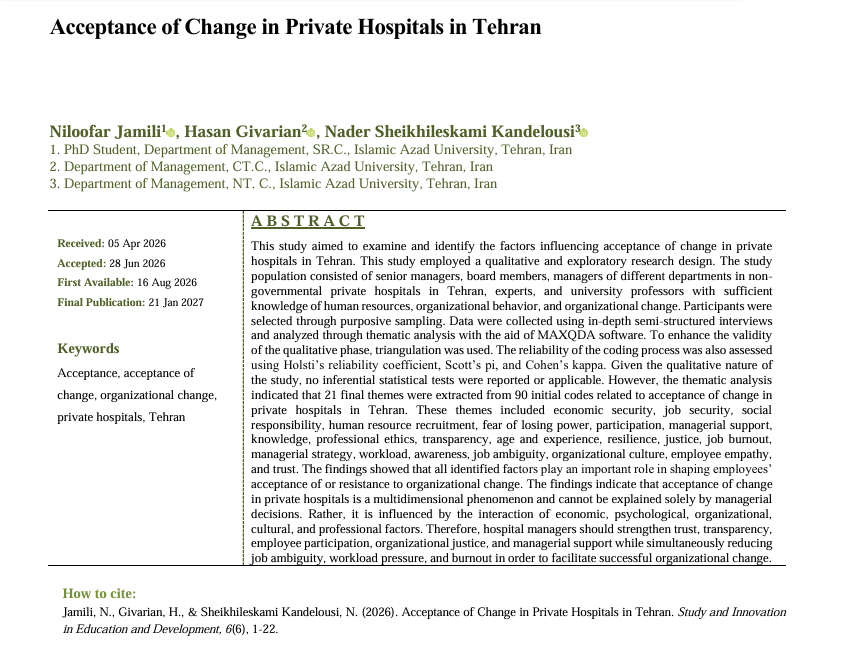
Acceptance of Change in Private Hospitals in Tehran
Keywords:
Acceptance, acceptance of change, organizational change, private hospitalsAbstract
This study aimed to examine and identify the factors influencing acceptance of change in private hospitals in Tehran. This study employed a qualitative and exploratory research design. The study population consisted of senior managers, board members, managers of different departments in non-governmental private hospitals in Tehran, experts, and university professors with sufficient knowledge of human resources, organizational behavior, and organizational change. Participants were selected through purposive sampling. Data were collected using in-depth semi-structured interviews and analyzed through thematic analysis with the aid of MAXQDA software. To enhance the validity of the qualitative phase, triangulation was used. The reliability of the coding process was also assessed using Holsti’s reliability coefficient, Scott’s pi, and Cohen’s kappa. Given the qualitative nature of the study, no inferential statistical tests were reported or applicable. However, the thematic analysis indicated that 21 final themes were extracted from 90 initial codes related to acceptance of change in private hospitals in Tehran. These themes included economic security, job security, social responsibility, human resource recruitment, fear of losing power, participation, managerial support, knowledge, professional ethics, transparency, age and experience, resilience, justice, job burnout, managerial strategy, workload, awareness, job ambiguity, organizational culture, employee empathy, and trust. The findings showed that all identified factors play an important role in shaping employees’ acceptance of or resistance to organizational change. The findings indicate that acceptance of change in private hospitals is a multidimensional phenomenon and cannot be explained solely by managerial decisions. Rather, it is influenced by the interaction of economic, psychological, organizational, cultural, and professional factors. Therefore, hospital managers should strengthen trust, transparency, employee participation, organizational justice, and managerial support while simultaneously reducing job ambiguity, workload pressure, and burnout in order to facilitate successful organizational change.
Downloads
References
1. Robbins SP, Judge TA. Organizational Behavior. 18th ed: Pearson; 2021.
2. Burnes B. Kurt Lewin and the planned approach to change: A re-appraisal. Journal of Management Studies. 2004;41(6):977-1002. doi: 10.1111/j.1467-6486.2004.00463.x.
3. Cameron E, Green M. Making Sense of Change Management: A Complete Guide to the Models, Tools and Techniques of Organizational Change: Kogan Page Publishers; 2019.
4. Augustsson H, Richter A, Hasson H, von Thiele Schwarz U. The need for dual openness to change: A longitudinal study evaluating the impact of employees' openness to organizational change content and process on intervention outcomes. The Journal of Applied Behavioral Science. 2017;53(3):349. doi: 10.1177/0021886317691930.
5. Deinert A, Homan AC, Boer D, Voelpel SC. Transformational leadership sub-dimensions and their link to leaders' personality and performance. The Leadership Quarterly. 2015;26:1095-120. doi: 10.1016/j.leaqua.2015.08.001.
6. Jiang Y, Chen CC. Integrating knowledge activities for team innovation: Effects of transformational leadership. Journal of Management. 2018;44:1819-47. doi: 10.1177/0149206316628641.
7. Pranitasari D. The influence of effective leadership and organizational trust to teachers work motivation and organizational commitment. Media Economy & Management. 2020;35(1):75-9. doi: 10.24856/mem.v35i1.1257.
8. Li J-Y, Sun R, Tao W, Lee Y. Employee coping with organizational change in the face of a pandemic: The role of transparent internal communication. Public Relations Review. 2021;47:101984. doi: 10.1016/j.pubrev.2020.101984.
9. Ashraf K. Coping with organizational changes in the coronavirus pandemic: The role of transparent internal communications in the judiciary of Kurdistan Province: Payam Noor University, Hamadan Branch; 2024.
10. Jin Y. Making sense sensibly in crisis communication: How publics' crisis appraisals influence their negative emotions, coping strategy preferences, and crisis response acceptance. Communication Research. 2020;37(4):522-52. doi: 10.1177/0093650210368256.
11. Stensaker I, Meyer C. Change experience and employee reactions: Developing capabilities for change. Personnel Review. 2025;41(1):106-24. doi: 10.1108/00483481211189974.
12. Aruppala D, Gunawardana KD, Mohamed Razi MJ. The nexus between digitalization, employee change management, and organizational productivity: A systematic literature review. Cogent Business and Management. 2026;13(1):2630419. doi: 10.1080/23311975.2026.2630419.
13. Gaile A, Zaumane I, Stibe A, Kivipold K. Expanding the success factors of change management by incorporating crisis preparedness in the emerging AI world. Review of Managerial Science. 2026:1-27. doi: 10.1007/s11846-026-00979-1.
14. Zulfiqar S, Saeed S. How corporate mindfulness leads to organizational agility? Exploring the roles of employee knowledge sharing and Toughness. Journal of Organizational Change Management. 2025. doi: 10.1108/JOCM-04-2023-0104.
15. Yustian OR, Ratnapuri CI. Digital Transformation, Change Management, and Organizational Resilience in the Culinary Sector in West Java. Iop Conference Series Earth and Environmental Science. 2025;1460(1):012008. doi: 10.1088/1755-1315/1460/1/012008.
16. Costa Barbosa M, Alam K, Mushtaq S. Water policy implementation in the state of São Paulo, Brazil: Key challenges and opportunities. Environmental Science & Policy. 2016;60:11-8. doi: 10.1016/j.envsci.2016.02.017.
17. Lin H, Zeng SX, Liu HJ, Li C. Bridging the gaps or fecklessness? A moderated mediating examination of intermediaries' effects on corporate innovation. Technovation Behavioral Science. 2018;47(4):461-524.
18. Shahabi H. Investigating the effect of change management on job satisfaction with the mediating role of employee productivity and moderating the reduction of resistance to change: Case study of National Iranian Drilling Company. Management and Accounting in the Third Millennium. 2024(31):1-15.
Downloads
Published
Issue
Section
License
Copyright (c) 2025 Niloofar Jamili, Hasan Givarian, Nader Sheikhileskami Kandelousi (Author)

This work is licensed under a Creative Commons Attribution-NonCommercial 4.0 International License.