Exploring the Concept of Sustainable Leadership: A Qualitative Study
DOI:
https://doi.org/10.61838/jsied.493Keywords:
Leadership, university, sustainable leadership, university managementAbstract
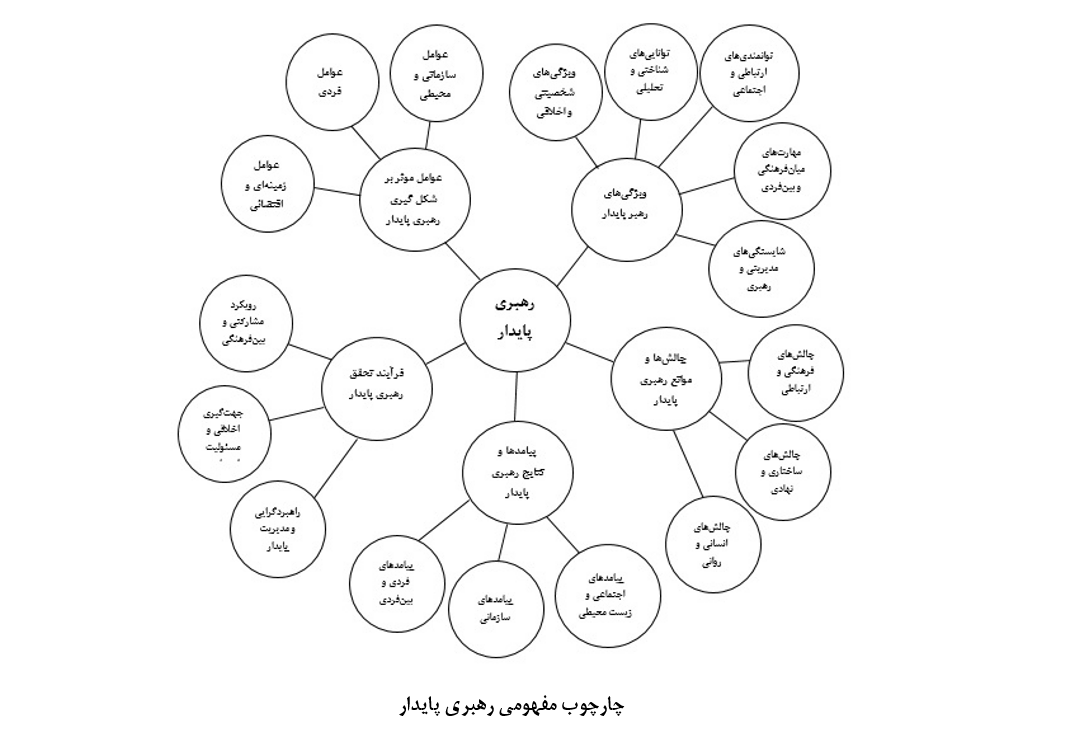
The purpose of this study was to systematically explore, conceptualize, and explain sustainable leadership and identify its dimensions, components, and consequences through a research synthesis approach. This qualitative study was conducted using a meta-synthesis approach. The research population consisted of Persian and English studies related to sustainable leadership published over the last twenty years. A systematic search was carried out in national and international scientific databases using relevant keywords. Studies were selected through purposive sampling based on predefined inclusion and exclusion criteria. Finally, 13 high-quality studies were analyzed using Sandelowski and Barroso’s seven-step synthesis framework and Strauss and Corbin’s three-stage coding process, including open, axial, and selective coding. Data analysis was performed using MAXQDA software. The credibility of findings was ensured through CASP quality assessment and inter-coder agreement procedures. The findings resulted in the identification of 133 open codes, 17 subcategories, and 5 main categories, including factors influencing sustainable leadership formation, characteristics of sustainable leaders, the process of sustainable leadership realization, challenges and barriers, and outcomes and consequences. Results indicated that sustainable leadership is shaped by organizational, individual, and contextual factors. Sustainable leaders were found to require competencies such as strategic thinking, cultural intelligence, ethical responsibility, conflict management, and intercultural communication skills. Moreover, the realization of sustainable leadership depends on participatory approaches, social responsibility, strategic orientation, and sustainability-based management. At the outcome level, sustainable leadership contributes to higher job satisfaction, organizational commitment, sustainable performance, improved organizational collaboration, and stronger social and environmental responsibility. Sustainable leadership is a multidimensional, ethical, and future-oriented phenomenon that integrates economic, social, cultural, and environmental dimensions to facilitate organizational and societal transformation. The findings suggest that developing this leadership style in universities and organizations requires revising managerial structures, strengthening participatory cultures, and training leaders equipped with intercultural competencies and systems thinking abilities.
Downloads
References
1. Gerard L, McMillan J, D'Annunzio-Green N. Conceptualising Sustainable Leadership. Industrial and Commercial Training. 2017;49(3):1-21. doi: 10.1108/ICT-12-2016-0079.
2. Liao Y. Sustainable Leadership: A Literature Review and Prospects for Future Research. 2022.
3. Peterlin J, Pearse N, Dimovski V. Strategic Decision Making for Organizational Sustainability: The Implications of Servant Leadership and Sustainable Leadership Approaches. Economic & Business Review. 2015;17(3):273-90.
4. Iqbal Q, Ahmad NH. Sustainable Development: The Colors of Sustainable Leadership in Learning Organization. Sustainable Development. 2020;29(1):108-19. doi: 10.1002/sd.2135.
5. Arar K, Oplatka I. Advanced Theories of Educational Leadership: Springer International Publishing; 2022.
6. Wang D, Feng T, Lawton A. Linking Ethical Leadership with Firm Performance: A Multi-Dimensional Perspective. Journal of Business Ethics. 2017;145(1):95-109. doi: 10.1007/s10551-015-2905-9.
7. Choi S, Ullah S, Kwak W. Ethical Leadership and Followers' Attitudes toward Corporate Social Responsibility: The Role of Perceived Ethical Work Climate. Social Behavior and Personality: An International Journal. 2015;43(3):353-65. doi: 10.2224/sbp.2015.43.3.353.
8. Dalati S, Raudeliūnienė J, Davidavičienė V. Sustainable Leadership, Organizational Trust on Job Satisfaction: Empirical Evidence from Higher Education Institutions in Syria. Business, Management and Education. 2017;15(1):14-27. doi: 10.3846/bme.2017.360.
9. Homayni Damirchi A. Designing and Explaining a Model of Good University Governance: The Case of University of Tehran. Tehran: University of Tehran; 2021.
10. Williams SS. Culturally Sustaining Leadership: Supporting the Resilience of Indigenous Students in the United States and Australia. Journal of School Leadership. 2020;30(6). doi: 10.1177/1052684620951725.
11. Washington A, Johnson L. Toward Culturally Sustaining/Revitalizing Indigenous Family-School-Community Leadership. Leadership in Education. 2023;8. doi: 10.3389/feduc.2023.1192095.
12. Taherpour F, Nasehian H. Analyzing the Relationship between Sustainable Leadership Skills and Co-Creation with the Mediation of Cognitive Trust among Faculty Members of the University of Birjand. Public Management Perspective. 2022(52):35-59.
13. Tolooyan G. A Systematic Review of the Foundations of Sustainable Human Resource Management. New Research Approaches in Management and Accounting. 2021;5(16):150-76.
14. Maleki B. A Model of Sustainable Cultural Leadership in Schools with Emphasis on the Culture of Care. Applied Educational Leadership Quarterly. 2025;6(2).
15. Akbari P, Nazari K, Dolat Yari F. Sustainable Leadership and Employees' Creative Self-Efficacy as Antecedents of Employees' Innovative Behavior: An Approach to Skill Training (Case Study: Agricultural Jihad Brokers of Kermanshah Province). Skill Training. 2024(47):157-76.
16. Hassanzadeh Pasikhani MS, Moazen Jamshidi MH, Bagherzadeh Khodashehri R. Designing a Sustainable Leadership Model in Facing the COVID-19 Crisis for Resilience in Food Industries (Case Study: Companies and Factories of Guilan Province). Organizational Resource Management Research. 2021;11(1):23-58.
17. Mohammadi T, Zahed Babelan A, Khaleghkhah A, Taghavi Qareh Bolagh H. Identifying Antecedents of Humble Leadership for Managers Using a Meta-Synthesis Approach. Public Management. 2025;17(1):187-220.
18. Mohammadi M, Karimi R. Construction and Validation of the Sustainable Ethical Leadership Scale in Iran's Higher Education System. Research and Planning in Higher Education. 2025;31(1):23-37.
19. Jalali Chimeh P, Mohammadian A, Roshandel Arbatani T, Salamzadeh A. Presenting an Entrepreneurial Competency Framework for Adolescent Education in Schools with a Sustainable Development Approach. Public Management. 2025;17(2):489-513.
20. Hanine S, Nita M. The Paradigm of Quantum Leadership: Ontology, Praxis and Application to Management. Revue Internationale des Sciences de Gestion. 2019;2(3):837-58.
21. Daemi F, Khashaei S, Sehat N. Presenting a Sustainable Leadership Model in Insurance Based on a Grounded Theory Approach. Insurance Research Journal. 2022(146):88-102.
Downloads
Published
Issue
Section
License
Copyright (c) 2025 Sajjad Bahmani (Author); Seyed Ali Siadat (Corresponding author); Leila Moghtadaei Khorasgani, Fateme Taherpour (Author)

This work is licensed under a Creative Commons Attribution-NonCommercial 4.0 International License.