Structural Equation Modeling of Sports Facility Safety Management at Imam Ali (PBUH) Officers University of the Islamic Republic of Iran from the Perspective of Development and Training
Keywords:
Safety management, sports facilities, military academy, functional developmentAbstract
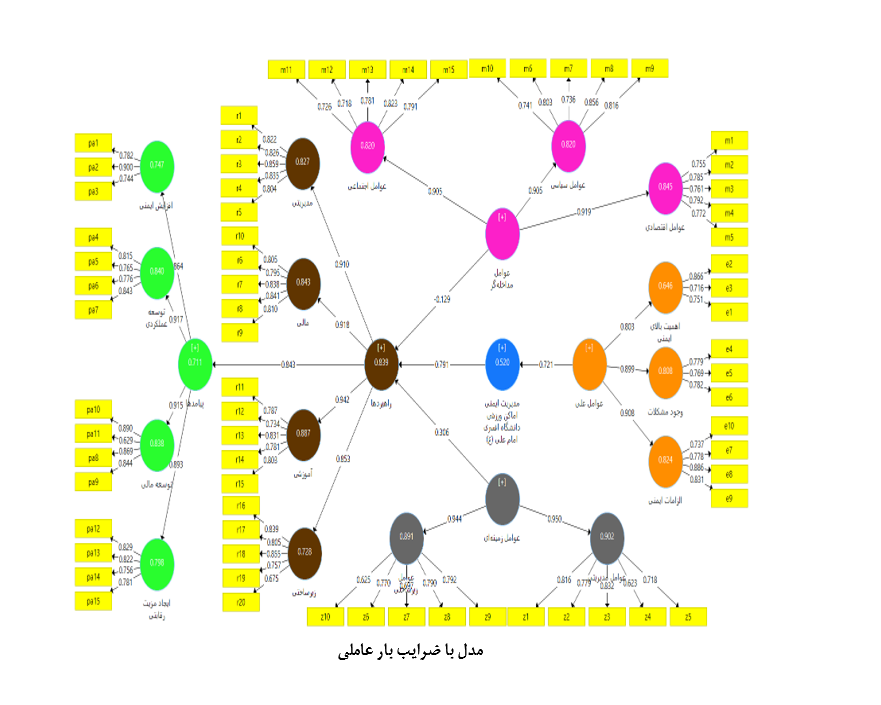
This study aimed to model sports facility safety management at Imam Ali (PBUH) Officers University of the Islamic Republic of Iran and to determine the structural relationships among causal factors, contextual factors, intervening factors, the core phenomenon, strategies, and outcomes associated with safety management. This applied quantitative study examined causal-correlational relationships among the components of sports facility safety management. The statistical population consisted of managers, coaches, and athletes participating in military sporting events at Imam Ali (PBUH) Officers University. Using G*Power software, the required sample size was estimated at 138 participants, who were recruited through convenience sampling. Data were collected using a researcher-made questionnaire developed from the findings of the qualitative phase of the research project. Face and content validity were assessed and confirmed by 10 experts, while construct validity was evaluated through convergent and discriminant validity indices. Reliability was examined using Cronbach’s alpha, composite reliability, and factor loadings. Structural equation modeling based on the partial least squares approach (PLS-SEM) was conducted using SmartPLS version 3.1.1 to test the hypothesized structural relationships. Structural equation modeling indicated that causal factors had a significant positive effect on the core phenomenon of safety management (β=0.721, t=9.876, p=0.001). The core phenomenon significantly and positively predicted safety-management strategies (β=0.791, t=6.767, p=0.001). Contextual factors also exerted a significant positive effect on strategies (β=0.306, t=3.757, p=0.001), whereas intervening factors had a significant negative effect on strategies (β=-0.129, t=2.173, p=0.001). Furthermore, strategies had a strong positive and significant effect on outcomes (β=0.843, t=29.247, p<0.001). All hypothesized structural paths were statistically significant at the 95% confidence level, supporting the adequacy of the proposed model. Sports facility safety management in a military university is a systematic and multidimensional process shaped by the interaction of causal, contextual, and intervening conditions with managerial, financial, educational, and infrastructural strategies. Strengthening facilitating conditions, reducing intervening barriers, and systematically implementing the identified strategies may enhance safety, functional and financial development, and competitive advantage within university sports facilities.
Downloads
References
1. Kumar H, Manoli AE, Hodgkinson IR, Downward P. Sport Participation: From Policy, Through Facilities, to Users’ Health, Well-Being, and Social Capital. Sport Management Review. 2018;21(5):549-62.
2. Edwards MB, Rowe K. Managing Sport for Health: An Introduction to the Special Issue. Sport Management Review. 2019;22(1):1-4.
3. Mozaffari SA. Planning and Management of Facilities and Sporting Venues. Tehran: Morabe Abi; 2009.
4. Kashef SM. Management of Sports Facilities and Spaces: Optimization Indicators in Design, Construction, and Operation. 1st ed: Urmia University Press; 2013.
5. Ornon GD, Fritschy JL, Ziltener JM. Professional Ice Hockey Injuries: A 4 Years Prospective Study. British Journal of Sports Medicine. 2018;45(4):366.
6. Hosseinpour E, Bagheri G, Alidoust Ghahfarokhi E, Amiri M, Jalali Farahani M. Developing a Safety Implementation Model in Sports Environments Using Grounded Theory. Research on Educational Sport. 2019(16):107-28.
7. Andrade A, Dominski FH. Indoor Air Quality of Environments Used for Physical Exercise and Sports Practice: Systematic Review. Journal of Environmental Management. 2018;206:577-86.
8. Dang VT, Nguyen HV, Hoang TH, Nguyen TH, Tran VT, Nguyen QH, et al. Gyms’ Indoor Environmental Quality and Customer Emotion: The Mediating Roles of Perceived Service Quality and Perceived Psychological Safety. Leisure Studies. 2022;41(2):263-80.
9. Takano T. Health and Environment in the Context of Urbanization. Environmental Health and Preventive Medicine. 2007;12:51-5.
10. Pourmirza S, Bahrami S, Eydi H. Examining Factors Affecting the Improvement of Health, Safety, and Environmental Culture in Sports Venues. Quarterly Journal of Environmental Education and Sustainable Development. 2020;9(3):83-96.
11. Khaleghinejad A, Ziaeddini M. Examining the Relationship Between Safety Climate and Employee Safety Performance Considering the Mediating Role of Safety Knowledge and Safety Motivation at Sarcheshmeh Copper Complex. Occupational Health and Safety. 2015;5(4):69-86.
12. Khakpour A, Samiei Zafargandi A. A Safety Performance Evaluation Model Based on Organizational Factors Affecting Industrial Safety Using a Fuzzy Inference System. Journal of Safety Promotion and Injury Prevention. 2015;3(1):25-34.
13. Soleymani Tapesari B, Mirshekari M. Prerequisites for Safety Management of Sports Venues in Sporting Events: A Qualitative Approach. Sport Physiology and Management Investigations. 2022;14(1):195-205.
14. Karimi P, Panahi M, Hosseini SS. Examining Safety Management of Sports Venues in Sporting Events in Schools of Zanjan Province. Innovation in Sports Management. 2022;1(2):151-65.
15. Shiralipour K, Amirnejad S, Sanaei M. Designing a Safety Management Model for Student Sports Events. Research on Educational Sport. 2022;11(1):51-68.
16. Doroudian AA, Shahbazi M, Akbari M. Identifying and Prioritizing Factors Affecting Crisis Management in Sports Venues: A Case Study of the 100,000-Seat Azadi Sports Stadium. Strategic Studies on Youth and Sports. 2022;21(55):257-72.
17. Allen B, Holmgren L, Hall SA. Professional Sport Venue Threats, Security Measures, and Technological Solutions. Global Sport Business Journal. 2025;10(1):2.
18. Ekrami Moghadam M, Rezaei M, Afarinesh Khaki A. Health, Safety and Environmental Management Based on Technology Field Theory in Sports Venues of the Ministry of Sports and Youth. Sport Management Journal. 2025.
19. Marsudi I, Fajar MK, Rusdiawan A, Kurniawan R, Rasyid MLSA, Susanto N, et al. Managing East Java’s Sports Facilities and Infrastructure for Achievement. International Journal of Human Movement and Sports Sciences. 2024;12(2):363-70.
20. Sayyd SM, Asnaldi A, bin Zainuddin ZA, Nahary AM. Management of Sports Facilities and Equipment in Physical Activities According to Saudi Vision 2030. Jurnal MensSana. 2022;7(2):118-25.
21. Rahimi N, Seyed Ameri M. Designing a Sustainable Safety Management Development Model in School Sports. Sport Management Journal. 2024;17(3):1-23.
22. Jeanes R, Spaaij R, Penney D, O’Connor J. Managing Informal Sport Participation: Tensions and Opportunities. International Journal of Sport Policy and Politics. 2019;11(1):79-95.
Downloads
Published
Issue
Section
License
Copyright (c) 2025 Abbas Shakibirad (Corresponding author); Sajjad Ghadami (Author)

This work is licensed under a Creative Commons Attribution-NonCommercial 4.0 International License.