Art Education as a Platform for Entrepreneurship: Identifying Dimensions and Components in the Second Cycle of Primary Education
DOI:
https://doi.org/10.61838/jsied.500Keywords:
Art Education, Primary Education, Creativity, Curriculum Development, Systematic ReviewAbstract
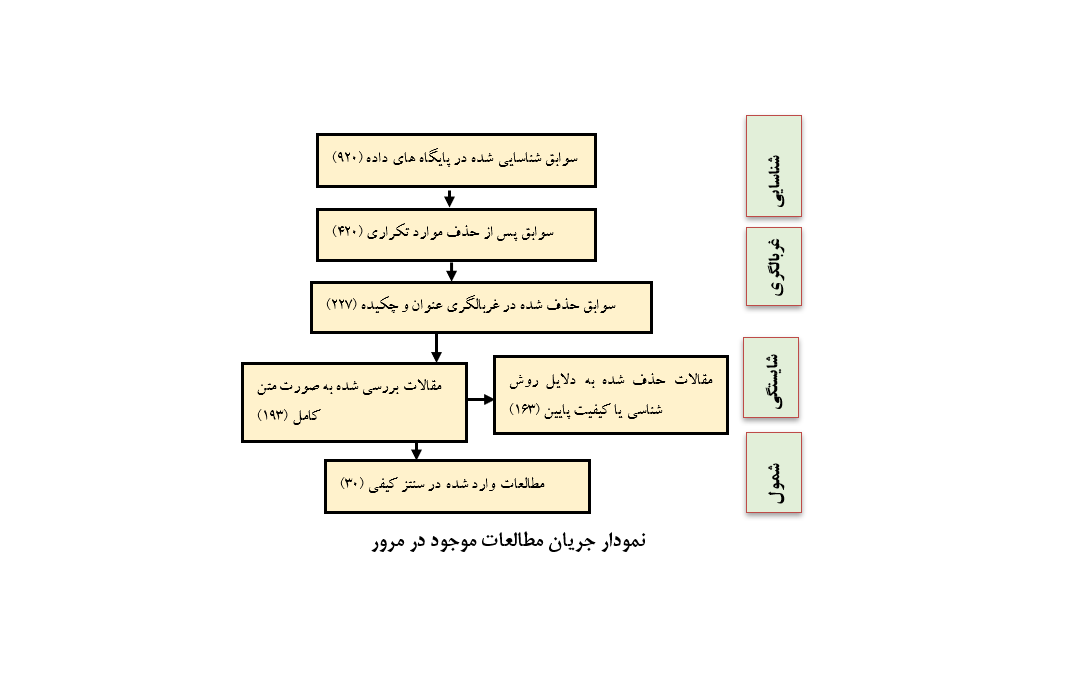
The present study aimed to identify and conceptualize the dimensions and components of entrepreneurship-oriented art education in the second cycle of primary education through a systematic literature review. This study employed a systematic review methodology. The research population consisted of peer-reviewed national and international studies related to art education, entrepreneurship education, and primary school curriculum published during the last decade. A structured search was conducted across Persian and English academic databases using relevant keywords, resulting in the identification of 970 initial records. After removing duplicates and conducting multi-stage screening based on inclusion and exclusion criteria, 30 studies, including 20 Persian and 10 English articles, were selected for final analysis. The screening and evaluation processes were independently conducted by two researchers, and reliability was confirmed using Cohen’s kappa coefficient and intraclass correlation coefficient (ICC). Data were analyzed through thematic analysis at open, axial, and selective coding levels using MAXQDA 2020 software. The findings revealed that entrepreneurship-oriented art education has a multidimensional and integrated structure organized into 6 major dimensions, 16 components, and 101 indicators. The identified dimensions included foundations of creativity and innovative thinking, creative agency and executive capability, the social context of artistic entrepreneurship, entrepreneurial foundations, manifestation of cultural-artistic capital in innovative action, and ethical and sustainability principles in artistic production and consumption. The results further demonstrated that art education can simultaneously enhance students’ cognitive, social, cultural, and ethical capacities in fostering entrepreneurial thinking and behavior. The findings suggest that entrepreneurship-oriented art education extends beyond the transmission of artistic skills and can function as a comprehensive educational framework for developing creativity, innovation, social responsibility, and entrepreneurial competencies among primary school students. The framework proposed in this study can serve as a foundation for curriculum development, instructional design, and educational policymaking aimed at nurturing creative and entrepreneurial learners.
Downloads
References
1. Mpuangnan K, Govender S, Mhlongo R. Approaches to Integrating Entrepreneurial Education in School Curriculum. Journal of Economics Education and Entrepreneurship. 2024;5(2):119. doi: 10.20527/jee.v5i2.10360.
2. Toscher B. Entrepreneurial Learning in Arts Entrepreneurship Education: A Conceptual Framework. Artivate: A Journal of Entrepreneurship in the Arts. 2019;8(1):3-22. doi: 10.1353/artv.2019.0003.
3. Herzig M, Renard S. The Impact of Improvisation Training in Arts Entrepreneurship Education on Creative Capacities. Journal of Entrepreneurship Education. 2024;27(S4):1-33.
4. Rezvani S, editor Examining the Impact of Art-Based Education on Students’ Creativity. Second International Conference of Top Teachers; 2025; Masjed Soleyman.
5. Darvishi Z, Shahidi S, Heidari M, Pakdaman S. The Effectiveness of Visual Arts Education Using the Educational Package “Art Education, Supporter of the Innovative Child” on Increasing Elementary Children’s Creativity. Psychology of Exceptional Individuals. 2015;5(17):85-109.
6. Kakouris A, Liargovas P. Introducing Art in Entrepreneurial Teaching: A Theoretical Framework. Proceedings of the 16th European Conference on Innovation and Entrepreneurship2022.
7. Wong HYH, Chan CKY. Conceptualising Arts Entrepreneurship Education: Bridging the Arts and Entrepreneurship within Higher Education Settings. Entrepreneurship Education. 2024;7:21-40.
8. Motiei M, Delbari SM, editors. Commonalities and Differences among Entrepreneurship, Art, and Artistic Entrepreneurship. Nineteenth National Conference on Management and Humanities Research in Iran; 2024; Tehran.
9. Potapchuk V, Bureau S. Using Art to Teach Entrepreneurship: Empirical Evidence of Efficiency of the Approach. European Academy of Management (EURAM) Conference 2016; Paris, France2016.
10. Arjmand Ghajour K, Arjmandi B. The Effectiveness of Creativity Development Programs in the Art Curriculum on Elementary Students’ Creativity. Rooyesh: Psychology and Educational Sciences. 2018;7(4):65-88.
11. Ajeri N, editor The Impact of Art on Students’ Creativity and Entrepreneurship. First International Conference of Top Teachers; 2024; Masjed Soleyman.
12. Alizadeh A, editor Fostering an Entrepreneurial Spirit in Elementary Education through Art. Fifth National Conference on Modern Research in Educational Sciences and Psychology in Iran; 2018; Tehran.
13. Niazian M, Taghipour H, editors. A Case Study of Art Education with an Approach to Creating an Entrepreneurial Spirit in Fifth-Grade Elementary Students in Noor County. First National Conference on Art Education; 2016.
14. Gholamrezaei M, Mohammadinejad A. A Qualitative Study of the Impact of Storytelling-Based Education on Strengthening Students’ Creativity. Research and Innovation in Education and Development. 2023;3(3):19-28.
15. Sedaghat L, Taheri Zoj A, Jamali A, Khavari S, Mirzania A, editors. How Was I Able to Create a Culture of Entrepreneurship and Creativity in the Art Course? Tenth Scientific Research Conference on Educational Sciences and Psychology, Social and Cultural Harms of Iran; 2022; Tehran.
16. Sadeghi Arani Z, Naderi Yeganeh S. The Role of Art in Promoting and Teaching Entrepreneurship: A Qualitative Content Analysis of Iranian Children’s and Adolescent Cinema Films over the Last Four Decades (1981–2021). Entrepreneurship Education and Management. 2023;2(2):21-42. doi: 10.22126/eme.2023.9219.1030.
17. Chilalu Mannathoko M. Bringing Entrepreneurship into Visual Arts and Music Classrooms: An Evaluation of Basic Education Arts Curriculum Implementation Strategies. Teaching Artist Journal. 2020;18(1):1-14. doi: 10.1080/15411796.2020.1851134.
18. Fernbach E. Social Entrepreneurship Education in Art Education of Future Primary School Teachers. Discourse and Communication for Sustainable Education. 2020;11(1):26-40. doi: 10.2478/dcse-2020-0004.
19. Thom M. The Rough Journey into Arts Entrepreneurship: Why Arts Entrepreneurship Education Is Still in Its Infancy in the UK and Germany. Education + Training. 2017;59(7-8):720-39. doi: 10.1108/ET-01-2016-0015.
20. De Ávila AL, Davel E. Entrepreneurship Education in the Arts: Perspectives and Challenges. Cadernos EBAPE BR. 2023;21(2). doi: 10.1590/1679-395120220097x.
21. Jadidi Mohammadabadi A, Ojand S, Salarian E, editors. The Impact of Art Education on the Development of Creativity and the Enhancement of Children’s Entrepreneurial Skills. Sixth National Conference on Modern Research in Humanities, Economics, and Accounting in Iran; 2020; Tehran.
22. Darabinejad F, Karimian Aliabadi F, Aghaei L, editors. Principles and Methods of Teaching and Promoting the Art of Entrepreneurship in Schools and Its Role in the Economic and Cultural Progress of Society. Fifth International Conference on Psychology, Educational Sciences, and Social Studies; 2022; Hamedan.
23. Motiei M, Seraj V, Montazeri Sanij F. The Status of Artistic Entrepreneurship Education in Iranian Universities: A Survey among Art Professors and Students. Karafan Quarterly. 2022;19(4):1-28.
24. Mohammadizadeh A, Yousefi E. Examining the Entrepreneurship and Employment Conditions of Graduates of Art and Metal Industries at Tabriz Islamic Art University. Ferdows-e Honar Quarterly. 2021;2(6):12-45.
25. Kialashaki J, Bagheri Toustani H, editors. The Role of Cultural and Artistic Entrepreneurship in Graduates’ Employment: A Case Study of Graduates of the Applied Science Center of Culture and Art, Unit 2, Mazandaran. International Conference on Entrepreneurship with the Motto of Entrepreneurial Talent Development: A Path toward Transformation; 2022.
26. Aghadavoudi M, Ghazizadeh K, Mirzamohammadi M. Evaluation of the Undergraduate Islamic Art Curriculum and Presentation of an Optimization Model from the Perspective of Entrepreneurship. Theoretical Foundations of Visual Arts. 2021;6(1):10-49.
27. Pourmahani M, editor Applied Training in the Culture and Art Course with an Entrepreneurship and Vocational Training Approach. Eighth International Conference on Modern Research in Psychology, Social Sciences, Educational Sciences, and Education; 2022.
28. Hossein Pourmahani M, editor Applied Training in the Culture and Art Course with an Entrepreneurship and Vocational Training Approach. Eighth International Conference on Modern Research in Psychology, Social Sciences, Educational Sciences, and Education; 2022.
29. Saffaran L, Khosravani Zanganeh M. The Impact of Art Education on the Development of Creativity, Innovation, and Enhancement of Entrepreneurial Skills among Preschool Children: A Case Study of Girls’ and Boys’ Preschool Children at Mobtaker Novin, District 5 of Tehran. Modern Marketing Research. 2015;5(0).
30. Abdokhodai Z, Tayouri A. Differences between Narrative Review and Systematic Review: Letter to the Editor. Iranian Journal of Medical Education. 2019;19(82):166-8.
Downloads
Published
Issue
Section
License
Copyright (c) 2025 Hashem Adiban, Hossein Zainalipour, S. Abdolvahab Samavi, Zohreh Moradi (Author)

This work is licensed under a Creative Commons Attribution-NonCommercial 4.0 International License.