Presenting an Organizational Co-Creation Model for Bank Saderat Iran Using a Qualitative and Quantitative Approach
DOI:
https://doi.org/10.61838/jsied.499Keywords:
Co-creation culture, organizational structure, processes and methods, technology and tools, value creationAbstract
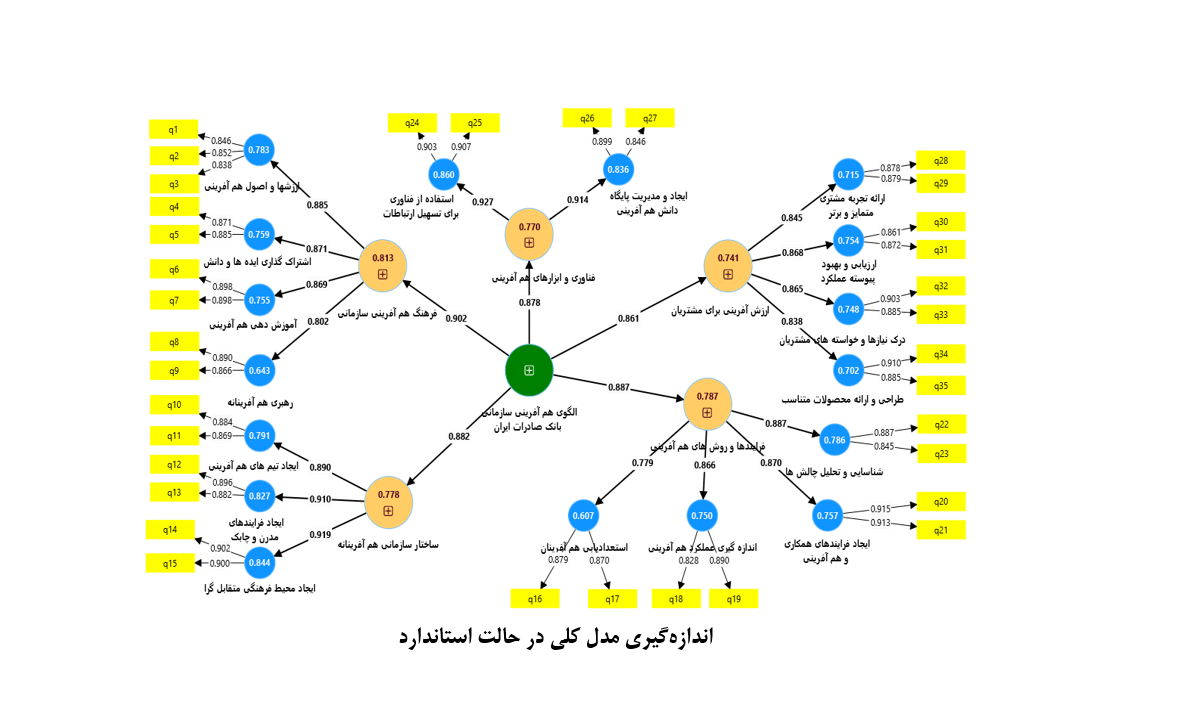
The present study aimed to develop and validate an organizational co-creation model for Bank Saderat Iran by identifying the dimensions, components, and structural relationships affecting organizational co-creation in the banking industry. This study employed an exploratory mixed-method design consisting of qualitative and quantitative phases. In the qualitative phase, 15 experts, managers, and specialists in public management and banking were selected through purposive sampling, and data were collected using semi-structured interviews. Qualitative data were analyzed through Braun and Clarke’s thematic analysis using MAXQDA software. In the quantitative phase, the statistical population included all managers and employees of Bank Saderat Iran during 2022–2023. Based on Cochran’s formula, 378 participants were selected using cluster random sampling. A researcher-made questionnaire developed from qualitative findings was used for data collection. Quantitative data were analyzed using confirmatory factor analysis and structural equation modeling through SPSS and Smart PLS software. The qualitative analysis resulted in 132 initial codes, 35 basic themes, 17 organizing themes, and 5 overarching themes, including organizational co-creation culture, co-creative organizational structure, co-creation processes and methods, co-creation technologies and tools, and customer value creation. Quantitative findings demonstrated that all structural paths were statistically significant, with t-values greater than 1.96 and significance levels below 0.01, confirming all proposed relationships. Furthermore, the ranking of dimensions showed that organizational co-creation culture ranked first (β=0.902), followed by co-creation processes and methods (β=0.887), co-creative organizational structure (β=0.882), co-creation technologies and tools (β=0.878), and customer value creation (β=0.861). The overall goodness-of-fit index also indicated a strong model fit. The findings indicated that achieving organizational co-creation in Bank Saderat Iran requires the development of a collaborative culture, agile organizational structures, effective co-creation processes, advanced technological infrastructures, and customer-centered value creation. Moreover, promoting co-creative leadership, facilitating knowledge sharing, and employing modern communication technologies can strengthen organizational interactions and foster innovation in the banking system. The proposed model may also serve as a practical framework for implementing organizational co-creation in other financial and service-oriented organizations.
Downloads
References
1. Saha V, Hollebeek LD, Mani V, Goyal P, Clark M. Value co-creation: a metatheory unifying framework and fundamental propositions. Marketing Intelligence & Planning. 2025. doi: 10.1108/MIP-03-2024-0163.
2. Roy SK, Singh G, Hatton C. Customers' motives to co-create in smart services interactions. Electronic Commerce Research. 2023;23:1367-400. doi: 10.1007/s10660-022-09633-w.
3. Zuhri S. Co-Creation Melalui Media Sosial: Kajian Pada Kampanye "Share a Coke" Kasus Coca Cola Di Indonesia. Bisman (Bisnis Dan Manajemen) the Journal of Business and Management. 2025;8(2):401-18. doi: 10.36815/bisman.v8i2.3945.
4. Wang Z, Yang X. Building brand loyalty through value co-creation practices in brand communities: the role of affective commitment and psychological brand ownership. Journal of Research in Interactive Marketing. 2025;19(2):201-20.
5. Malik MI, Ahsan R. Towards innovation, co-creation and customers' satisfaction: A banking sector perspective. Asia Pacific Journal of Innovation and Entrepreneurship. 2019;13(3):311-25. doi: 10.1108/APJIE-01-2019-0001.
6. Abror A, Patrisia D, Engriani Y, Noor NMBM, Omar MW, Hafizh MA, et al. Antecedents of customer value co-creation in Islamic banking: The role of religiosity, perceived value and behavioral factors. Cogent Business & Management. 2023;10(3). doi: 10.1080/23311975.2023.2259577.
7. Wulandari N, Nasution RA. Integrated value co-creation and affective commitment in banking industry. 2019. doi: 10.3846/btp.2019.47.
8. Ferm LEC, Thaichon P. Value co-creation and social media: Investigating antecedents and influencing factors in the U.S. retail banking industry. Journal of Retailing and Consumer Services. 2021;61. doi: 10.1016/j.jretconser.2021.102548.
9. Le HN, Pham TAN, Pham TN. The transformative outcomes of frontline employee adaptability for service value co-creation: A study of the banking sector. International Journal of Bank Marketing. 2022;40(3):401-24. doi: 10.1108/IJBM-03-2021-0093.
10. Taherpour F. Designing and validating a measurement scale for co-creation in the university. Public Management Perspective. 2021(45):135-55.
11. Turunen A, editor Co-creating and validating customer value in Higher Education IT Services using Service Design. EPiC Series in Computing; 2025.
12. Harandi A, Parhizgar MM, Fazel A, Amini MT. A conceptual model of academic value co-creation with emphasis on fourth- and fifth-generation universities using meta-synthesis and fuzzy Delphi approaches. Management of Governmental Organizations. 2021;10(1):103-24.
13. Javashi Jadid S, Taheri Kia F, Jalali M, Tabrizian B. A model of value co-creation with customers in the tourism industry. Innovation Management in Defense Organizations. 2020;3(1):119-46.
14. Hassanzadeh M, Delafrooz N, Gholipour Soleimani A, Shahroudi K. Explaining the model of customer value co-creation behavior in the development of the medical tourism industry in Guilan Province. Urban Tourism. 2021;8(2):141-59.
15. Parvari P. Value co-creation in customer-solution-based business networks in the software industry. Technology Development Management. 2022;10(2):153-80.
16. Oklevik O, Nysveen H, Pedersen PE. Exploring the relationship between co-creation (DART), brand experience strength, and brand satisfaction: A brand engagement perspective. Journal of Marketing Theory and Practice. 2024;32(1):1-24. doi: 10.1080/10696679.2022.2120013.
17. Shaikh S, Gummerum M. A Luxury Consumption Perspective On motivations for Brand Value Co-Creation in Emerging Markets. International Journal of Emerging Markets. 2025. doi: 10.1108/ijoem-10-2023-1637.
18. Rahman Seresht H, Khashaei Varnamkhasti V, Ebrahimi M, Rahimian M. Strategic value co-creation model in the Iranian banking industry: Value creation in a new paradigm. Public Management Research. 2018;11(40):27-52.
19. Rahman Seresht H, Sheikhi N. Value co-creation in Iranian banking: An analysis of value creation elements and relationships. Public Management Research. 2019;12(46):95-122.
20. Kooshki AA, Alizadeh Meshkani F, Feqhi Farahmand N. Validation of the customer value co-creation model in the banking industry: A case study of Bank Mellat. Financial Engineering and Securities Management. 2022.
21. Kooshki AA, Alizadeh Meshkani F, Feqhi Farahmand N. Presenting a model of customer value co-creation to encourage investment in the banking industry from a phenomenological perspective. Investment Knowledge. 2023;12(45):395-418.
22. Shakibi H, Shabgoo Monsef SM, Gholipour Soleimani A. A model of brand value co-creation with customers for regional planning. Geography (Regional Planning). 2023;13(52):339-56.
23. Rahmati M. Presenting a co-creation model in the tourism industry using the qualitative grounded theory method. Tourism Development Planning. 2020;9(33):229-46.
24. Keshavarz Y, Jamshidi D. Service quality evaluation and the mediating role of perceived value and customer satisfaction in customer loyalty. International Journal of Tourism Cities. 2018;4(2):220-44. doi: 10.1108/IJTC-09-2017-0044.
Downloads
Published
Issue
Section
License
Copyright (c) 2025 Fatemeh Askarian Amiri (Author); Asadollah Mehrara (Corresponding author); Seyedeh Shayesteh Varedi (Author)

This work is licensed under a Creative Commons Attribution-NonCommercial 4.0 International License.