The Disconnected Link between Philosophy of Religion and Primary Education: A Critical Analysis of Research Gaps in Children’s Meaning-Making
DOI:
https://doi.org/10.61838/jsied.447Keywords:
Philosophy of religion, elementary education, child's search for meaning, religious education, research gapAbstract
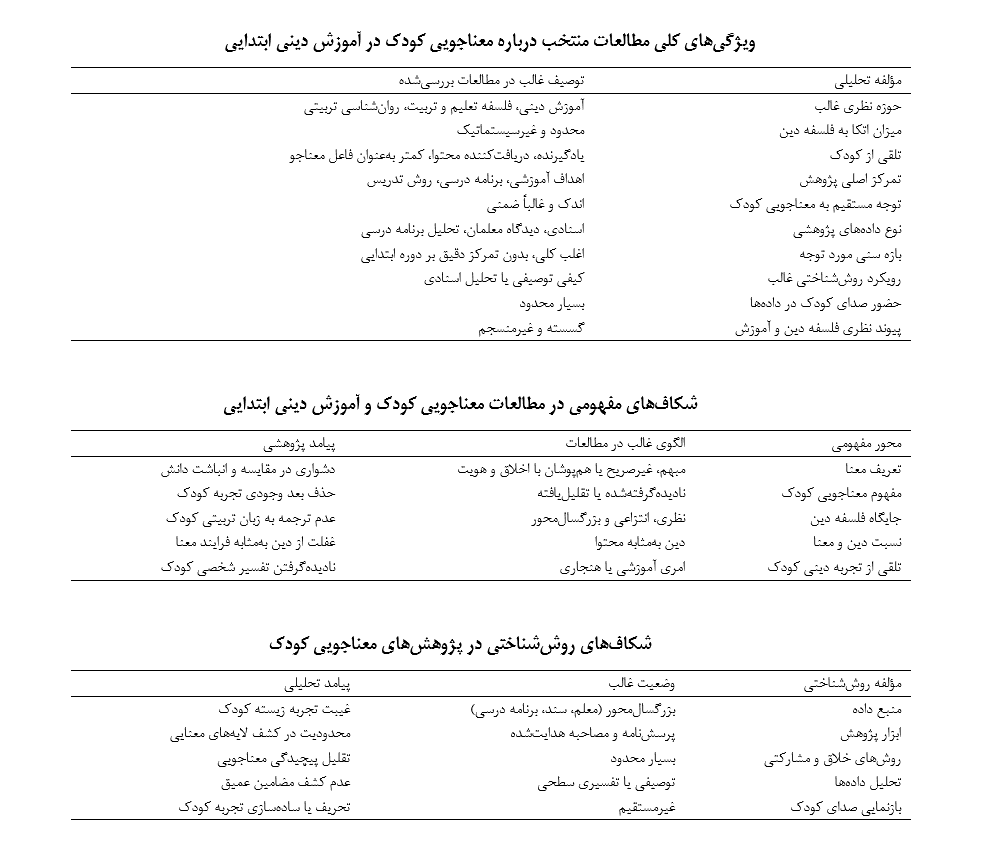
This study aims to identify and explain conceptual, methodological, and pedagogical gaps in the relationship between philosophy of religion and primary education with a focus on children’s meaning-making. Using a qualitative approach, this study adopted a systematic critical literature review. Relevant scholarly works in philosophy of religion, religious education, philosophy of education, and children’s meaning-making were screened, resulting in the selection of 17 articles. Data were collected through close textual analysis and examined using theoretical thematic analysis. The findings indicate that children’s meaning-making is often implicitly addressed and conceptually underdeveloped in religious education research. Adult-centered methodologies marginalize children’s lived experiences, while pedagogical practices reveal a persistent gap between philosophical depth and classroom application, limiting opportunities for active meaning construction. Reconnecting philosophy of religion with primary education requires integrative frameworks that recognize children as active meaning-makers and reposition religious education as a space for reflective and meaningful engagement.
Downloads
References
1. Hay D, Nye R. The Spirit of the Child. 2 ed. London: Jessica Kingsley; 2006.
2. Matthews GB. The Philosophy of Childhood. Cambridge, MA: Harvard University Press; 1994.
3. Robinson C. Children's Spirituality: A Systematic Review of Empirical Research. Journal of Religious Education. 2022;70(1):19-35. doi: 10.1007/s40839-021-00153-4.
4. Hick J. An Interpretation of Religion: Human Responses to the Transcendent. 2 ed. New Haven, CT: Yale University Press; 2004.
5. Plantinga A. Warranted Christian Belief. New York, NY: Oxford University Press; 2000.
6. Gearon L. MasterClass in Religious Education: Transforming Teaching and Learning. London: Bloomsbury; 2013.
7. Jackson R. Signposts: Policy and Practice for Teaching about Religions and Non-Religious Worldviews in Intercultural Education. Strasbourg: Council of Europe; 2014.
8. Lipman M. Thinking in Education. 2 ed. Cambridge: Cambridge University Press; 2003.
9. Abrami PC, Bernard RM, Borokhovski E, Waddington DI, Wade CA, Persson T. Strategies for teaching students to think critically: A meta-analysis. Review of Educational Research. 2015;85(2):275-314. doi: 10.3102/0034654314551063.
10. Balcı Ö, Eryılmaz A. The impact of Philosophy for Children (P4C) activities on the speaking skills of gifted students. Frontiers in Psychology. 2024;15:1451532. doi: 10.3389/fpsyg.2024.1451532.
11. Jirásek I, Jágerová K. Czech primary school teachers’ experience with the P4C approach. Cambridge Journal of Education. 2024;54(1):37-52. doi: 10.1080/0305764X.2024.1984512.
12. Kim S. Linking knowledge-justification with peers to the learning of collaborative reasoning. Journal of Moral Education. 2024;53(1):72-88. doi: 10.1080/03057240.2024.1998742.
13. Freathy R, John HC. Religious Education, Big Ideas and the Study of Worldviews. British Journal of Educational Studies. 2019;67(1):27-40. doi: 10.1080/00071005.2018.1533507.
14. Martela F, Steger MF. The Three Meanings of Meaning in Life: Distinguishing Coherence, Purpose, and Significance. The Journal of Positive Psychology. 2016;11(5):531-45. doi: 10.1080/17439760.2015.1137623.
15. Steger MF. Meaning in Life: Theory, Research, and Practice. New York, NY: Springer; 2018.
16. Tabataba'i MH. Al-Mizan fi Tafsir al-Qur'an (Selected Volumes). Qom: Islamic Publications Office; 1984.
17. Javadi Amoli A. Fitrah in the Qur'an. Qom: Esra Publications; 2010.
18. Motahari M. Human and Faith. Tehran: Sadra Publications; 2023.
19. Davoudi M. Philosophy of Islamic Education. Tehran: SAMT Publications; 2017.
20. Hosseinikhaah A. An Analysis and Explanation of Spiritual Education and a Brief Review of Curriculum Elements in This Domain. Teaching Research Quarterly. 2018;6(3):95-211.
21. Chaharbashlou H, Karimi B. Pathologies of Religious Education in the Preschool Period: A Phenomenological Study. Research in Islamic Education Issues. 2024;31(62):11-44.
22. Muraidin J. A Literature Review: The Impact of Religious Education Implementation on Mental Health and Psychological Well-Being of Elementary School Children. Misool Jurnal Pendidikan Dasar. 2025;7(2):70-80. doi: 10.47945/misool.v7i2.2292.
23. Anwar M, Hidayat R, Suryana T. Development of the concept of Islamic education to build and improve the personality of school-age children. Multidisciplinary Reviews. 2024;7(1):72-84. doi: 10.31893/multirev.2024139.
24. Sembiring RA. The integration of Islamic educational philosophy with 21st-century pedagogy: Challenges and opportunities. Journal of Curriculum and Global Citizenship Studies. 2024;9(1):55-70. doi: 10.1111/jcgcs.2024.288.
25. Bagheri K, Khosravi Z. Cultural foundations of philosophy for children: The case of Iran. Thinking: The Journal of Philosophy for Children. 2012;20(3):3-10. doi: 10.5840/thinking20122032.
26. Yusof MNM. Islamization of contemporary education: Reconstructing philosophy for children from an Islamic perspective. Islamiyyat. 2020;42(1):45-54. doi: 10.17576/islamiyyat-2020-4201-05.
27. Ab Wahab N. Philosophy for Children: A systematic literature review on its challenges and opportunities. Children. 2022;9(11):1671. doi: 10.3390/children9111671.
28. Hashemi ZS. Reconceptualizing Philosophy for Children through Islamic Educational Thought: A Theoretical and Comparative Framework. Journal of Applied Philosophy in Educational Studies. 2025;3(1):1-8. doi: 10.61838/japes.3.1.8.
29. Wan Daud WMN. The educational philosophy and practice of Syed Muhammad Naquib al-Attas: An exposition of the original concept of Islamization: ISTAC; 2013.
30. Hashim R. Educational dualism in Malaysia: Implications for theory and practice. American Journal of Islamic Social Sciences. 2014;31(1):45-67. doi: 10.35632/ajiss.v31i1.285.
31. D’Olimpio L. The limits to dialogue: Rethinking deliberation in P4C. Oxford Review of Education. 2024;50(2):215-32. doi: 10.1080/03054985.2024.2011234.
32. Haynes J, Murris K. Picturebooks, pedagogy and philosophy: Routledge; 2012.
Downloads
Published
Issue
Section
License
Copyright (c) 2025 زهرا سادات هاشمی (نویسنده مسئول)

This work is licensed under a Creative Commons Attribution-NonCommercial 4.0 International License.